9 results
02/Jul/2025
02/Jul/2025
DOI: 10.31744/einstein_journal/2025RW1134
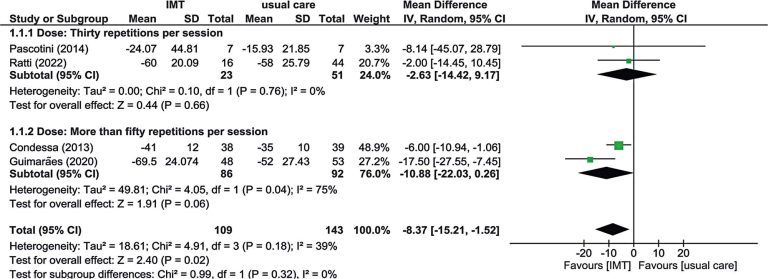
ABSTRACT Objective To systematically review and analyze studies investigating the efficacy and safety of inspiratory muscle training in adult chronic critically ill patients. Methods The MEDLINE, Embase, CENTRAL, LILACS, Clinical Trials Registry, and World Health Organization databases were queried on November 24, 2022 and January 22, 2025. The review was conducted in accordance with the PRISMA guidelines. RevMan V5.4 was used to analyze mean differences or standardized mean differences and 95% confidence intervals (95%CIs) for continuous variables and risk ratios […]
Keywords: Breathing exercises; Chronic disease; Critical illness; Intubation, intratracheal; Muscle strength; Respiration artificial; Respiratory muscles; Tracheostomy
25/Apr/2025
DOI: 10.31744/einstein_journal/2025AO0705
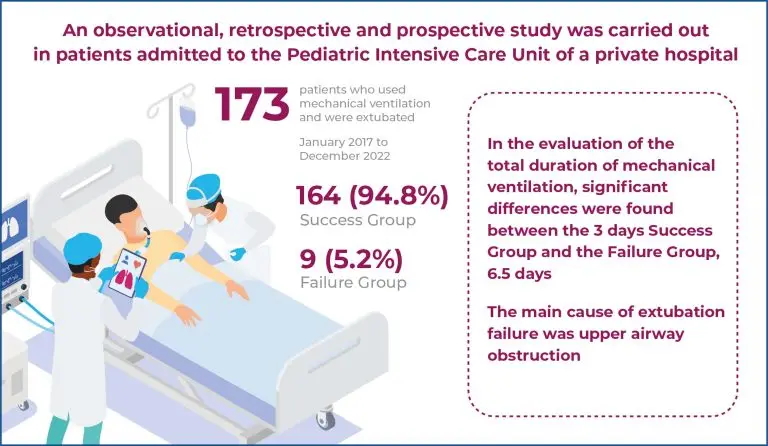
Highlights ■ In patients who experienced extubation failure, the total ventilation time was twice as long as that of patients with successful extubation. ■ The incidence of extubation failure was 5.2%, which is relatively low compared to other studies. ■ The study revealed no significant association between the presence of pre-existing illnesses and extubation outcomes. ■ Results indicated that the primary cause of extubation failure was upper airway obstruction, accounting for 67% of cases requiring reintubation. ABSTRACT Objective: To compare […]
Keywords: Airway extubation; Child; Intensive care units; Pediatric; Respiration artificial; Ventilator weaning
05/Jul/2023
05/Jul/2023
DOI: 10.31744/einstein_journal/2023AO0233
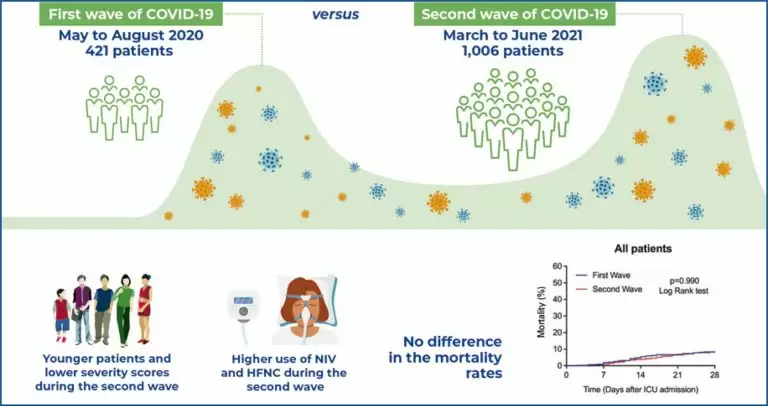
Highlights We compared characteristics between patients admitted during the first and second waves. There were 1,427 intensive care unit patients with COVID-19: 421 (first wave) and 1,006 (second wave). The patients in the second wave were younger and less severely ill at the time of intensive care unit admission. Patients exhibited similar mortality rates and need for invasive organ support. ABSTRACT Objective To describe and compare the clinical characteristics and outcomes of patients admitted to intensive care units during the […]
Keywords: Coronavirus infections; COVID-19; Critical care outcomes; Extracorporeal membrane oxygenation; Intensive care units; Mortality; Noninvasive ventilation; Respiration artificial; SARS-CoV-2
22/Nov/2021
22/Nov/2021
DOI: 10.31744/einstein_journal/2021AO6739
ABSTRACT Objective: To describe clinical characteristics, resource use, outcomes, and to identify predictors of in-hospital mortality of patients with COVID-19 admitted to the intensive care unit. Methods: Retrospective single-center cohort study conducted at a private hospital in São Paulo (SP), Brazil. All consecutive adult (≥18 years) patients admitted to the intensive care unit, between March 4, 2020 and February 28, 2021 were included in this study. Patients were categorized between survivors and non-survivors according to hospital discharge. Results: During the […]
Keywords: Betacoronavirus; Coronavirus; Coronavirus infections; COVID-19; Critical care outcomes; Extracorporeal membrane oxygenation; Intensive care units; Mortality; Noninvasive ventilation; Respiration artificial; SARS-CoV-2
01/Jul/2017
01/Jul/2017
DOI: 10.1590/S1679-45082017AO4081
ABSTRACT Objective To compare mechanical ventilation time, need for non-invasive ventilation, length of intensive care unit stay, and hospital stay after liver transplant in cirrhotic patients with and with no diagnosis of hepatopulmonary syndrome. Methods This was a prospective cohort study with a convenience sample of 178 patients (92 with hepatopulmonary syndrome) who were diagnosed as alcoholic or hepatitis C virus cirrhosis. The statistical analysis included Kolmogorov-Smirnov test and Students t test. Data were analyzed using SPSS version 16.0, and […]
Keywords: Hepatopulmonary syndrome/complications; Intensive care units; Length of stay; Liver cirrhosis/etiology; Noninvasive ventilation; Respiration artificial
01/Apr/2017
DOI: 10.1590/S1679-45082017AO3913
ABSTRACT Objective To assess whether the spontaneous breathing test can predict the extubation failure in pediatric population. Methods A prospective and observational study that evaluated data of inpatients at the Pediatric Intensive Care Unit between May 2011 and August 2013, receiving mechanical ventilation for at least 24 hours followed by extubation. The patients were classified in two groups: Test Group, with patients extubated after spontaneous breathing test, and Control Group, with patients extubated without spontaneous breathing test. Results A total […]
Keywords: Child; Intensive care units; Respiration artificial; Ventilator weaning
01/Jan/2017
DOI: 10.1590/S1679-45082017AO3865
ABSTRACT Objective To describe the microbiological characteristics and to assess the risk factors for mortality of ventilator-associated tracheobronchitis in a case-control study of intensive care patients. Methods This case-control study was conducted over a 6-year period in a 40-bed medical-surgical intensive care unit in a tertiary care, private hospital in São Paulo, Brazil. Case patients were identified using the Nosocomial Infection Control Committee database. For the analysis of risk factors, matched control subjects were selected from the same institution at […]
Keywords: Bronchitis/mortality; Intensive care units; Microbiology; Respiration artificial; Risk Factors
31/Jan/2014
DOI: 10.1590/S1679-45082013000400011
OBJECTIVE: To compare ideal PaO2 with PaO2 found, ideal PaO2/FiO2 of room air with the one found, and ideal FiO2 with FiO2 found in mechanically ventilated elderly patients. METHODS: Cross-sectional study that evaluated elderly mechanically ventilated patients for at least 72 hours and who underwent three subsequent blood gas analyses. RESULTS: The sample consisted of 48 elderly with mean age of 74.77±9.36 years. There was a significant difference between the ideal PaO2 and the one found (p
Keywords: Aged; Aging; Intensive care units; Oxigenation; Pulmonary gas exchange; Respiration artificial
01/Jul/2010
DOI: 10.1590/S1679-45082010AO1632
ABSTRACT Objective: To identify the frequency of intracranial hemorrhage and its associated factors in premature newborns. Methods: A cross-sectional study based on a survey of medical records of premature neonates submitted to transfontanellar ultrasound at a hospital located in a southern neighborhood of the city of São Paulo, in 2007. Results: A 50% rate of intracranial hemorrhage was found among premature newborns submitted to transfontanellar ultrasound, and 15.35% among all premature babies born in this hospital in 2007. The statistically […]
Keywords: Infant, premature; Intracranial hemorrhages/epidemiology; Respiration artificial; Risk Factors; Ultrasonography