09/Jun/2026
Anabolic androgenic steroids are human enhancement drugs, not necessarily substance abuse
DOI: 10.31744/einstein_journal/2026RW1998
ABSTRACT This essay examines human enhancement drugs – particularly anabolic-androgenic steroids – through the lens of public health theory from the Global South. It critiques prohibitionist policies, which criminalize users while disregarding social determinants, as well as extreme relativism, which reduces consumption to individual autonomy alone. In contrast, harm reduction emerges as an evidence-based, user-centered approach that rejects criminalization, upholds human rights, and provides contextualized health responses. By reframing anabolic-androgenic steroids as human enhancement drugs, the analysis promotes a less […]
Keywords: Anabolic androgenic steroids; Harm reduction; Lifestyle; Patient-centered care; Public health
09/Jun/2026
Reconstructing medical practice: political-philosophical reflections on care from a Brazilian healthcare context
DOI: 10.31744/einstein_journal/2026RW2282
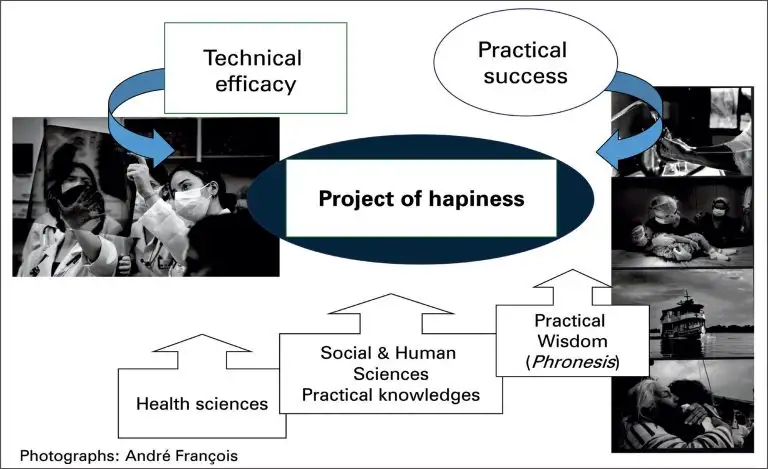
ABSTRACT This essay presents a political-philosophical reflection on the need to reconstruct health practices in order to make them more effective and sensitive in identifying and responding to the needs of diverse individuals and populations. To this end, it draws on the experience of health sector reforms in Brazil and the development of the Brazilian Public Health System, focusing in particular on the relevance of three conceptual constructs associated with this process: comprehensiveness, vulnerability, and care. Inspired by philosophical hermeneutics […]
Keywords: Comprehensive healthcare; Hermeneutics; Philosophy of medicine; Public health; Social markers of difference; Social medicine; Social vulnerability
12/Sep/2025
Hallux valgus surgery in the public health system of Brazil
DOI: 10.31744/einstein_journal/2025AO1053
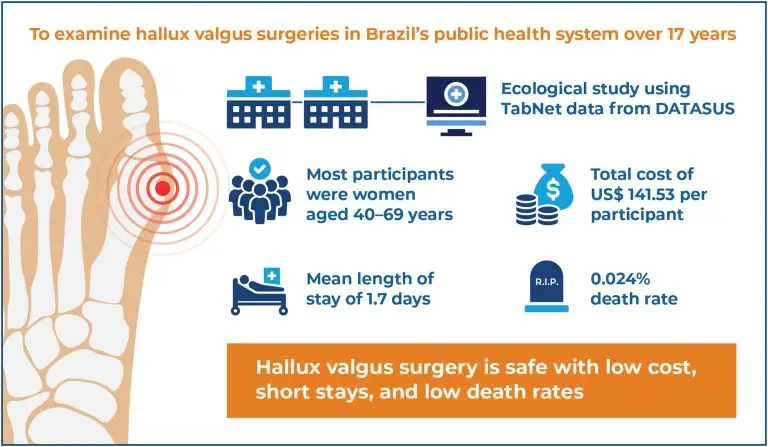
Highlights ■ Public hospitals in Brazil performed 37,741 hallux valgus surgery procedures between January 2008 and October 2024. ■ The study population consisted of 79.7% females, with the most common age group being 40-69 years (67.7%). The mean length of stay was 1.7 days. ■ The mean cost per patient was US$ 141.53. ■ The overall mortality count was nine, corresponding to a death rate of 0.024%. ABSTRACT Objective: This study aimed to describe patient profiles and analyze costs, hospital […]
Keywords: Cost of illness; Foot; Hallux valgus; Mortality; Orthopedic procedures; Osteotomy; Public health
19/Aug/2025
What happened to the most frequent surgeries performed in the Brazilian Unified Health System during and after the COVID-19 pandemic? An analysis of 2 million procedures
einstein (São Paulo). 19/Aug/2025;23:eAO1399.
View Article19/Aug/2025
What happened to the most frequent surgeries performed in the Brazilian Unified Health System during and after the COVID-19 pandemic? An analysis of 2 million procedures
DOI: 10.31744/einstein_journal/2025AO1399
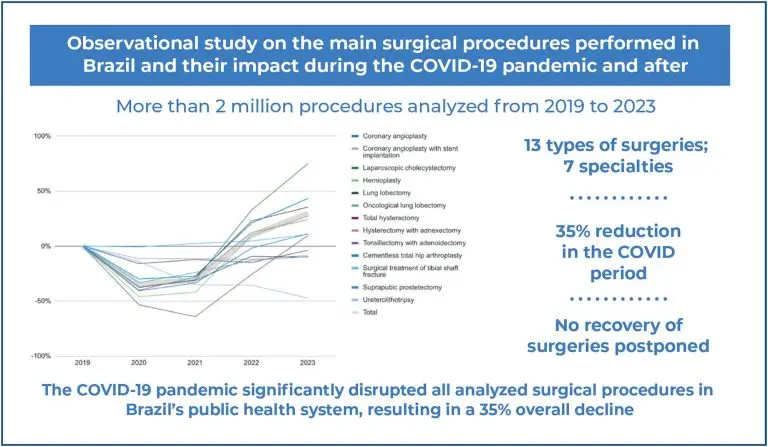
Highlights ■ More than 2 million procedures were analyzed in the public health system from 2019 to 2023. ■ A total of 13 types of procedures were performed across 7 different specialties. ■ A 35% reduction in the total number of surgeries was observed. ■ There was no recovery of surgeries postponed during the pandemic. ABSTRACT Objective: To analyze changes in surgical volume across different specialties in Brazil before, during, and after the COVID-19 pandemic. Methods: This descriptive observational study […]
Keywords: Brazil; Brazilian Unified Health System; COVID-19; Health Information Management; Health services needs and demand; Pandemics; Public health; Surgical procedures, operative
08/Aug/2025
Cost-benefit analysis of implementing Vendor Neutral Archive (VNA) technology in the Brazilian Public Health System
einstein (São Paulo). 08/Aug/2025;23:eGS1219.
View Article08/Aug/2025
Cost-benefit analysis of implementing Vendor Neutral Archive (VNA) technology in the Brazilian Public Health System
DOI: 10.31744/einstein_journal/2025GS1219
Highlights ■ Vendor Neutral Archive implementation has an return on investment of 5.63% in the first year and 10.12% after three years. ■ At least 11,500 exams are needed annually for a positive return on investment in the first year after implementation. ■ Vendor Neutral Archive enhances interoperability and efficiency by standardizing and centralizing image storage. ■ Scalability is key: higher adoption of Vendor Neutral Archive leads to greater financial and operational benefits. ABSTRACT Objective: To conduct an ex-ante cost-benefit […]
Keywords: Brazil; Cloud computing; Cost-benefit analysis; Diagnostic imaging; Government programs; Information storage and retrieval; Public health; Radiology Information Systems; System integration; Vendor neutral archive
11/Jul/2025
Analysis of the distribution of health services in the State of São Paulo: focus on Big Data
DOI: 10.31744/einstein_journal/2025AO1070
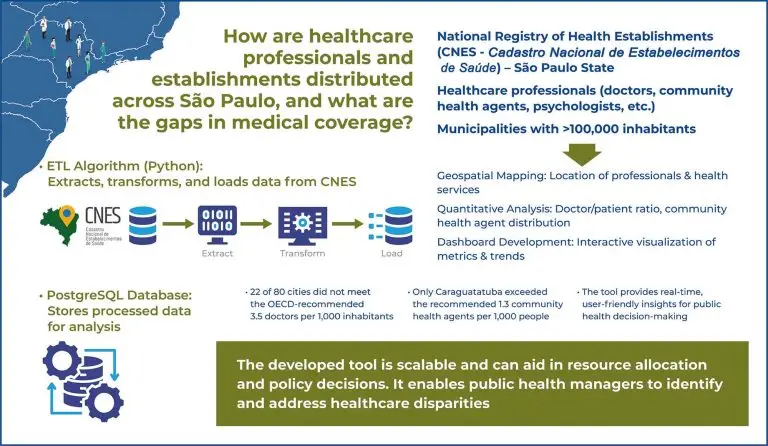
Highlights ■ The extract, transform, and load algorithm automates data extraction and updates in the PostgreSQL database. ■ The interactive dashboard enables detailed queries on establishments and professionals. ■ Results highlight medical doctor deficit in 22 cities and a shortage of community agents. ■ The tool can scale and assist managers in resource allocation for healthcare. ABSTRACT Objective: To develop a process (pipeline) for extracting, processing, and analyzing data from the National Registry of Health Establishments in the State of […]
Keywords: Apache Spark; Big data; CNES; Dashboard systems; Database; Geographic locations; Health facilities; Health personnel; Health Services Accessibility; PostgreSQL; Power BI; Public health
28/Mar/2025
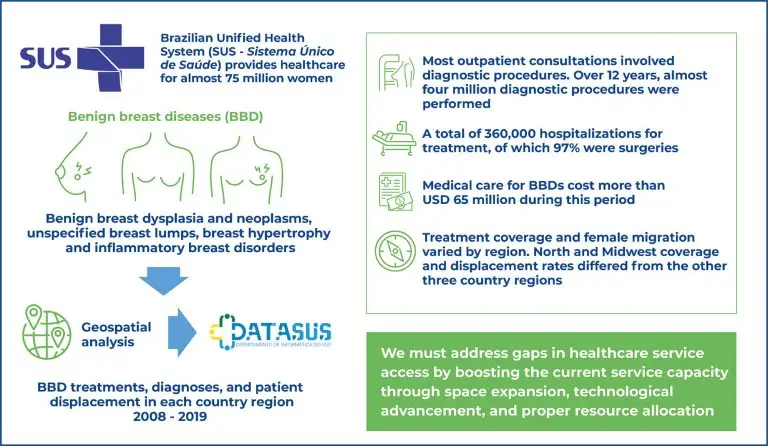
Brazil’s benign breast disease care profile and geospatial analysis
DOI: 10.31744/einstein_journal/2025AO1132
Highlights ■ Most outpatient consultations comprised diagnostic procedures. ■ In the past 12 years, medical care for benign breast diseases has cost >USD 65 million. ■ Women from North and Midwest Brazil had higher diagnosis and treatment displacement rates. ABSTRACT Objective: To quantitatively and geospatially analyze coverage and displacement for the diagnosis and treatment of benign breast diseases in the Brazilian Unified Health System between 2008 and 2019. Methods: Datasets from the Brazilian Ministry of Health were used to survey […]
Keywords: Brazil; Breast diseases; Breast neoplasms; Demography; Epidemiology; Health expenditures; Healthcare costs; Hospitalization; Incidence; Primary healthcare; Public health; Strategy planning; Unified Health System
02/Jul/2024
Overview of global healthcare policies for patients with chronic kidney disease: an integrative literature review
DOI: 10.31744/einstein_journal/2024RW0519
ABSTRACT Introduction Chronic kidney disease is a progressive and irreversible loss of kidney function and considerably affects the lives of patients and their families. Its high incidence necessitates efficient public policies for prevention and treatment. However, policies for chronic kidney disease education and awareness are scarce. Objective To evaluate global public policies for the prevention and treatment of chronic kidney disease adopted in various regions, aiming to comprehend the differences between various models. Methods This integrative review followed PRISMA recommendations […]
Keywords: Health Services Accessibility; Kidney failure, chronic; Public health; Public Policy; Renal insufficiency, chronic; Universal health care
20/May/2024
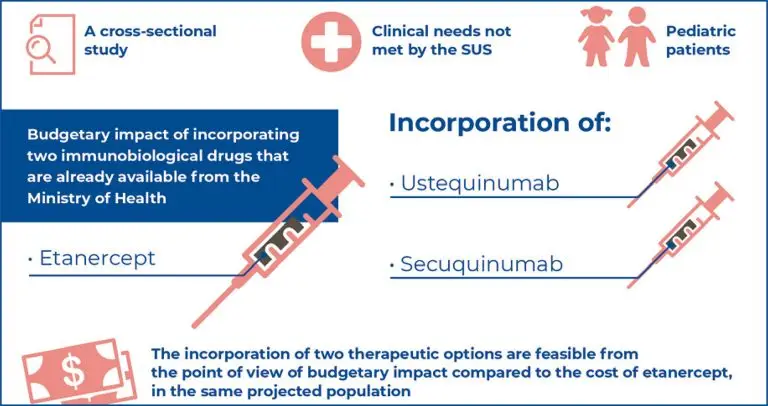
Unmet need for and impact of adopting immunobiological drugs for moderate to severe plaque psoriasis in a pediatric population
DOI: 10.31744/einstein_journal/2024GS0413
Highlights Incorporation of secukinumab and ustekinumab was economically feasible. These drugs are options for those who do not respond to or have contraindications to etanercept. ABSTRACT Objective: Therefore, this study aimed to evaluate the impact of secukinumab and ustekinumab against moderate-to-severe plaque psoriasis in a Brazilian pediatric population with access to public healthcare. Methods: A survey of immunobiological treatments registered for use against pediatric psoriasis at the National Health Surveillance Agency was conducted. These treatments were compared to the list […]
Keywords: Child; Etanercept; Evaluation studies as topic; Health surveillance; Psoriasis; Public health; Secukinumab; Therapeutics; Ustekinumab
09/May/2024
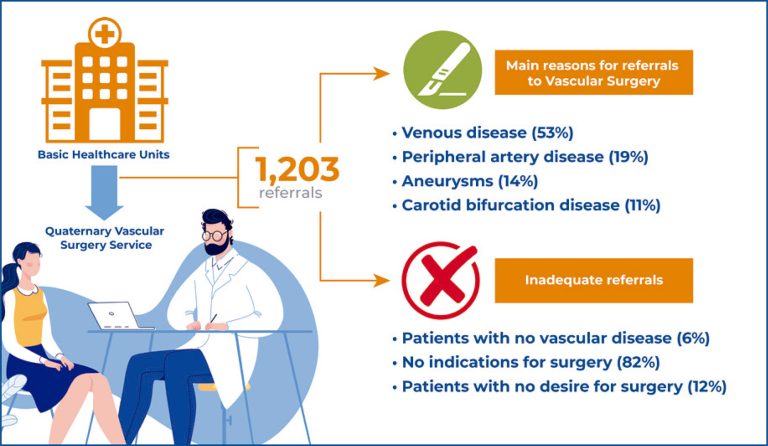
Retrospective analysis of 1,203 cases of referral to a quaternary vascular surgery outpatient clinic within the Unified Health System, São Paulo, Brazil
einstein (São Paulo). 09/May/2024;22:eAO0676.
View Article09/May/2024
Retrospective analysis of 1,203 cases of referral to a quaternary vascular surgery outpatient clinic within the Unified Health System, São Paulo, Brazil
DOI: 10.31744/einstein_journal/2024AO0676
Highlights Forty-three percent of referrals from basic healthcare units to a specialized vascular surgical service were regarded as inappropriate. The main reasons for inappropriate referrals included study participants without an indication for surgery and those referred to the wrong specialty. A high proportion of inappropriate referrals resulted in the subutilization of highly complex services. Use of telemedicine will assist in reducing the rate of inappropriate referrals. ABSTRACT Objective: Consequently, in this study, we aimed to evaluate 1,203 cases of referral […]
Keywords: Patient-referral systems; Public health; Telemedicine; Tertiary care centers; Vascular surgical procedures