17/Dec/2025
Effect of non-invasive ventilation and high-flow nasal cannula on hospital mortality in COVID-19-induced acute respiratory failure: a meta-analysis
einstein (São Paulo). 17/Dec/2025;24:eRW0695.
View Article17/Dec/2025
Effect of non-invasive ventilation and high-flow nasal cannula on hospital mortality in COVID-19-induced acute respiratory failure: a meta-analysis
DOI: 10.31744/einstein_journal/2026RW0695
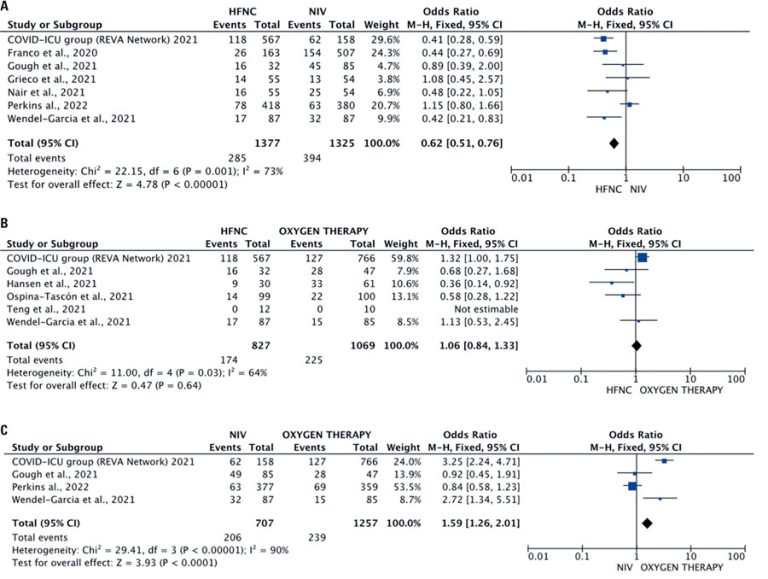
ABSTRACT Background Non-invasive respiratory support strategies, such as high-flow nasal cannula therapy and non-invasive ventilation, were widely employed during the coronavirus disease 2019 (COVID-19) pandemic, yet their comparative effectiveness remains uncertain. Objective To compare the effects of high-flow nasal cannula therapy, non-invasive ventilation, and conventional oxygen therapy on intubation rates and hospital mortality in adults with COVID-19-related acute respiratory failure. Methods A systematic review and meta-analysis was conducted following PRISMA and Cochrane guidelines, with searches performed in nine databases for […]
Keywords: COVID-19; Intubation; Mortality; Noninvasive ventilation; Oxygen inhalation therapy; Respiratory insufficiency; SARS-CoV-2
Clinical characteristics and outcomes of patients with COVID-19 admitted to the intensive care unit during the first and second waves of the pandemic in Brazil: a single-center retrospective cohort study
05/Jul/2023
Clinical characteristics and outcomes of patients with COVID-19 admitted to the intensive care unit during the first and second waves of the pandemic in Brazil: a single-center retrospective cohort study
einstein (São Paulo). 05/Jul/2023;21:eAO0233.
View Article05/Jul/2023
Clinical characteristics and outcomes of patients with COVID-19 admitted to the intensive care unit during the first and second waves of the pandemic in Brazil: a single-center retrospective cohort study
DOI: 10.31744/einstein_journal/2023AO0233
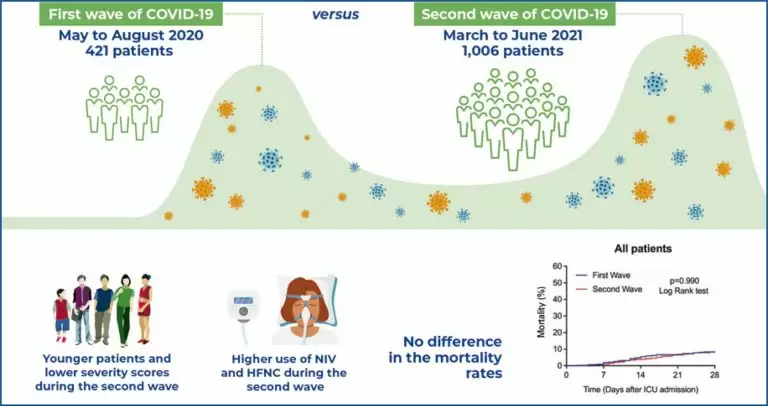
Highlights We compared characteristics between patients admitted during the first and second waves. There were 1,427 intensive care unit patients with COVID-19: 421 (first wave) and 1,006 (second wave). The patients in the second wave were younger and less severely ill at the time of intensive care unit admission. Patients exhibited similar mortality rates and need for invasive organ support. ABSTRACT Objective To describe and compare the clinical characteristics and outcomes of patients admitted to intensive care units during the […]
Keywords: Coronavirus infections; COVID-19; Critical care outcomes; Extracorporeal membrane oxygenation; Intensive care units; Mortality; Noninvasive ventilation; Respiration artificial; SARS-CoV-2
Clinical characteristics and outcomes of COVID-19 patients admitted to the intensive care unit during the first year of the pandemic in Brazil: a single center retrospective cohort study
22/Nov/2021
Clinical characteristics and outcomes of COVID-19 patients admitted to the intensive care unit during the first year of the pandemic in Brazil: a single center retrospective cohort study
einstein (São Paulo). 22/Nov/2021;19:eAO6739.
View Article22/Nov/2021
Clinical characteristics and outcomes of COVID-19 patients admitted to the intensive care unit during the first year of the pandemic in Brazil: a single center retrospective cohort study
DOI: 10.31744/einstein_journal/2021AO6739
ABSTRACT Objective: To describe clinical characteristics, resource use, outcomes, and to identify predictors of in-hospital mortality of patients with COVID-19 admitted to the intensive care unit. Methods: Retrospective single-center cohort study conducted at a private hospital in São Paulo (SP), Brazil. All consecutive adult (≥18 years) patients admitted to the intensive care unit, between March 4, 2020 and February 28, 2021 were included in this study. Patients were categorized between survivors and non-survivors according to hospital discharge. Results: During the […]
Keywords: Betacoronavirus; Coronavirus; Coronavirus infections; COVID-19; Critical care outcomes; Extracorporeal membrane oxygenation; Intensive care units; Mortality; Noninvasive ventilation; Respiration artificial; SARS-CoV-2
01/Jul/2017
Ventilatory support and hospital stay after liver transplant in cirrhotic patients with hepatopulmonary syndrome
einstein (São Paulo). 01/Jul/2017;15(3):322-6.
View Article01/Jul/2017
Ventilatory support and hospital stay after liver transplant in cirrhotic patients with hepatopulmonary syndrome
DOI: 10.1590/S1679-45082017AO4081
ABSTRACT Objective To compare mechanical ventilation time, need for non-invasive ventilation, length of intensive care unit stay, and hospital stay after liver transplant in cirrhotic patients with and with no diagnosis of hepatopulmonary syndrome. Methods This was a prospective cohort study with a convenience sample of 178 patients (92 with hepatopulmonary syndrome) who were diagnosed as alcoholic or hepatitis C virus cirrhosis. The statistical analysis included Kolmogorov-Smirnov test and Students t test. Data were analyzed using SPSS version 16.0, and […]
Keywords: Hepatopulmonary syndrome/complications; Intensive care units; Length of stay; Liver cirrhosis/etiology; Noninvasive ventilation; Respiration artificial