02/Apr/2026
Feasibility of transthoracic echocardiography in the prone position with a low-cost adaptation: morphological, functional, and hemodynamic analysis
einstein (São Paulo). 02/Apr/2026;24:eAO1802.
View Article02/Apr/2026
Feasibility of transthoracic echocardiography in the prone position with a low-cost adaptation: morphological, functional, and hemodynamic analysis
DOI: 10.31744/einstein_journal/2026AO1802
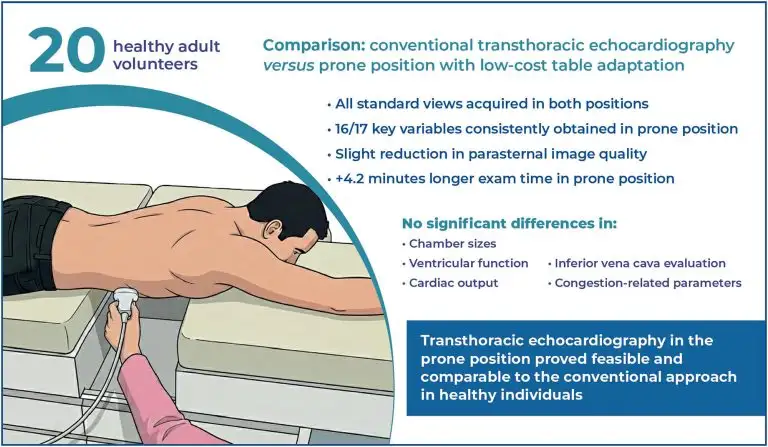
Highlights ■ All standard echocardiographic views were obtained in the prone position. ■ In the prone position, 16 of 17 key variables were consistently acquired. ■ Image quality was slightly reduced only in the parasternal view. ■ Quantitative measurements were comparable between the prone and supine positions. ABSTRACT Objective: Transthoracic echocardiography is essential for hemodynamic assessment in critically ill patients; however, its use in the prone position remains challenging. This study aimed to assess the feasibility of performing transthoracic echocardiography […]
Keywords: Echocardiography, transthoracic; Equipment design; Hemodynamics; Point-of-care systems; Prone position
01/Apr/2026
One-dimensional computational circulatory models: a scoping review
DOI: 10.31744/einstein_journal/2026RW1854
ABSTRACT Background Computational modeling of human circulatory system has evolved significantly in recent decades. Among the various modeling strategies, one-dimensional (1D) models have emerged as alternatives to more complex models because of their balance between physiological accuracy and computational efficiency. Objective This scoping review aimed to summarize and compare the studies on 1D computational models of the entire circulatory system, including those that incorporated additional 0D and 3D components. Methods A systematic search was performed for studies on computational 1D […]
Keywords: Cardiovascular system; Hemodynamics; Mathematical computing; Models
21/Oct/2024
Uncomplicated circulatory shock: a narrative review
DOI: 10.31744/einstein_journal/2024RW0775
ABSTRACT Circulatory shock is a common fatal condition. Despite this, information on this syndrome in the current medical literature is fragmented and esoteric. Adherence to each basic element of care can have a profound impact on patient outcomes. Disturbances in pumping (cardiogenic), content/container relationship (hypovolemic and vasoplegic), or blockage in blood circulation (obstructive) can induce tissue hypoperfusion, causing hemodynamic shock. If not quickly reversed, hypoperfusion progresses to irreversible multi-organ failure. The course can be fatal even before reaching this stage […]
Keywords: Adrenal insufficiency; Anaphylaxis; Cardiac output; Cardiac tamponade; Fluid therapy; Hemodynamic monitoring; Hemodynamics; Intensive care units; Pulmonary embolism; Shock; Shock, cardiogenic; Shock, hemorrhagic; Shock, septic
17/Jun/2021
Strategies for hemodynamic maintenance of potential brain-dead donor: integrative review
DOI: 10.31744/einstein_journal/2021RW5630
ABSTRACT Objective To learn about the scientific production on strategies adopted for hemodynamic maintenance of brain-dead patients. Methods Integrative review with articles published between 2007 and 2019, in Scientific Electronic Library Online (SciELO), Latin American and Caribbean Health Sciences Literature (LILACS), PubMed® and ScienceDirect. The descriptors “ Hemodinâmica AND Morte Encefálica ” and “Hemodynamics AND Brain Death” were used. Exclusion criteria were non-human research and gray literature. Results A total of 21 articles were listed. As strategies, the use of […]
Keywords: Brain death; Hemodynamics; Nursing care; Organ transplantation
06/Feb/2019
Near-infrared spectroscopy parameters in patients undergoing continuous venovenous hemodiafiltration
DOI: 10.31744/einstein_journal/2019AO4439
ABSTRACT Objective To investigate the impacts of continuous venovenous hemodiafiltration on the microcirculation in patients with acute kidney injury. Methods A prospective observational pilot study conducted in a 40-bed, open clinical-surgical intensive care unit of a private tertiary care hospital located in the city of São Paulo (SP), Brazil. Microcirculation was assessed using near-infrared spectroscopy by means of a 15mm probe placed over the thenar eminence. Vascular occlusion test was performed on the forearm to be submitted to near-infrared spectroscopy […]
Keywords: Acute kidney injuries; Critical care; Hemodynamics; Microcirculation; Oxygenation; Renal replacement therapy; Spectroscopy, near-infrared
01/Oct/2015
Bedside echocardiography in critically ill patients
DOI: 10.1590/S1679-45082015MD3271
ABSTRACT The echocardiography has become a vital tool in the diagnosis of critically ill patients. The use of echocardiography by intensivists has been increasing since the 1990’s. This tool has become a common procedure for the cardiovascular assessment of critically ill patients, especially because it is non-invasive and can be applied in fast and guided manner at the bedside. Physicians with basic training in echocardiography, both from intensive care unit or emergency department, can assess the left ventricle function properly […]
Keywords: Cardiac output; Echocardiography; Hemodynamics; Intensive care; Shock; Ventricular function
21/Aug/2015
How to choose the therapeutic goals to improve tissue perfusion in septic shock
DOI: 10.1590/S1679-45082015RW3148
The early recognition and treatment of severe sepsis and septic shock is the key to a successful outcome. The longer the delay in starting treatment, the worse the prognosis due to persistent tissue hypoperfusion and consequent development and worsening of organ dysfunction. One of the main mechanisms responsible for the development of cellular dysfunction is tissue hypoxia. The adjustments necessary for adequate tissue blood flow and therefore of oxygen supply to metabolic demand according to the assessment of the cardiac […]
Keywords: Hemodynamics; Microcirculation; Resuscitation; Sepsis; Shock, septic; Vasoconstrictor agents