einstein (São Paulo). 23/Apr/2026;24:eAO1865.
Use of the OSCE in assessing performance in first aid of high school students

DOI: 10.31744/einstein_journal/2026AO1865
Highlights
■ Training markedly improves theoretical knowledge and performance in cardiopulmonary resuscitation and foreign body airway obstruction management.
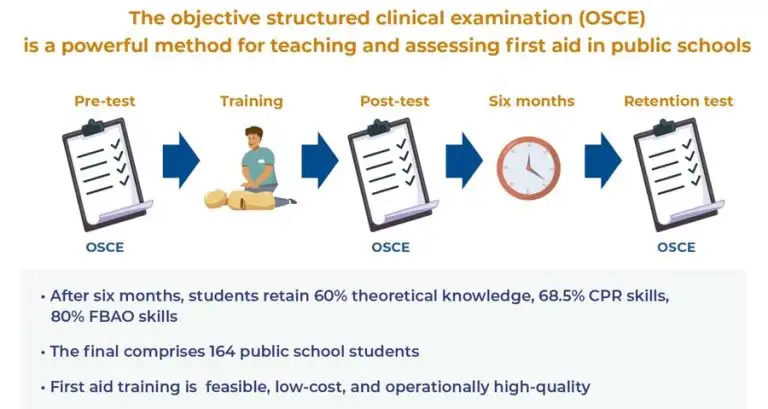
■ Significant knowledge and skills, particularly in the Heimlich maneuver, remain after 6 months.
■ The objective structured clinical examination is a practical and reliable method to evaluate first-aid skills in schools.
ABSTRACT
Objective:
To assess the knowledge and performance of high school students in cardiopulmonary resuscitation and foreign body airway obstruction management using an objective structured clinical examination.
Methods:
An interventional design was implemented with high school students, who were assessed before and after the intervention. Participants completed a theoretical questionnaire and two objective structured clinical examinations—one for cardiopulmonary resuscitation and one for foreign body airway obstruction—before receiving theoretical and practical first aid training. Subsequent assessments included the same theoretical questionnaire and objective structured clinical examinations, administered immediately after training and again after six months to measure knowledge retention.
Results:
Comparison of pre-training, immediate post-training, and six-month follow-up data revealed significant improvements in knowledge and performance across all student groups and scenarios (p<0.001), with sustained retention over time. Implications for School Health Policy, Practice, and Equity: Utilizing handmade mannequins alongside the objective structured clinical examination methodology offers a cost-effective approach for training students and mitigating adverse outcomes in high schools.
Conclusion:
The objective structured clinical examination is an effective and evaluative tool for first aid training among high school students.
[…]