einstein (São Paulo). 13/Aug/2026;24:eAO2267.
Disparities in disease profiles among Afro-Brazilians and public healthcare patients with prostate cancer: real-world data from Brazil

DOI: 10.31744/einstein_journal/2026AO2267
Highlights
■ Descriptive analysis of 2,387 patients treated at private and public hospitals.
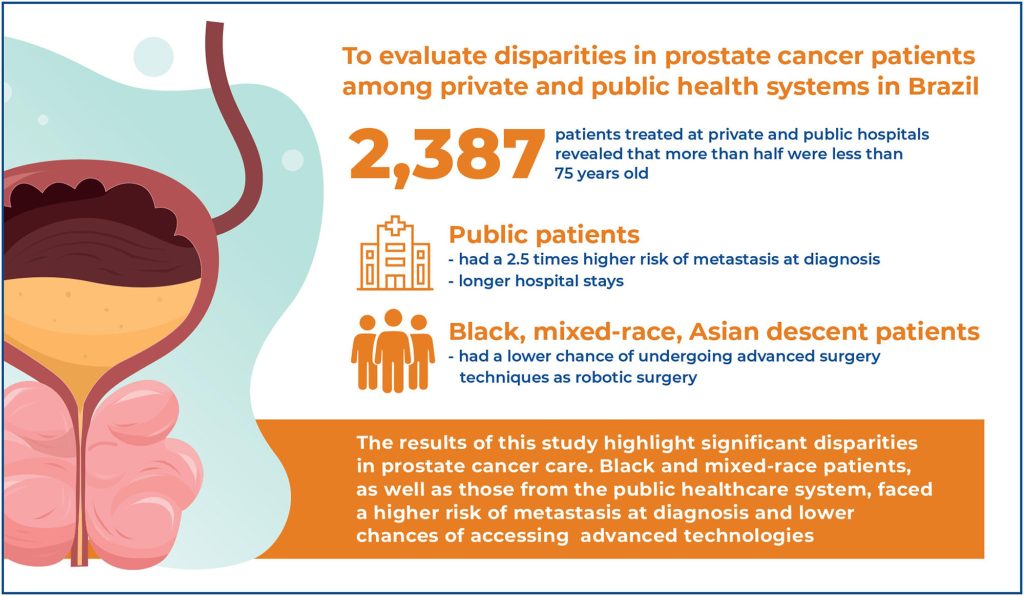
■ Public patients had a 2.5 fold higher risk of metastasis at diagnosis when compared to private service patients, and longer hospital stays.
■ Regarding race, Black and mixed-race patients had a higher risk of metastasis at diagnosis than whites and a lower chance of undergoing advanced surgery techniques such as robotic surgery.
■ Patients aged more than 75 years have statistically worse overall survival.
ABSTRACT
Objective:
To evaluate disparities in patients with prostate cancer treated at private or public health systems in Brazil.
Methods:
Anonymized retrospective and prospective data were collected from the medical records of patients over 18 years old diagnosed with prostate cancer between 2017 and 2024.
Results:
A descriptive analysis of 2,387 patients treated at private or public hospitals revealed that more than half were younger than 75 years old. Regarding race, 58% of patients reported their ethnicity: 75.41% identified as white, 13.84% mixed-race, 7.35% Black, 3.32% Asian, and 0.07% Indigenous. Public hospital patients had a 2.5-fold higher risk of metastasis at diagnosis (p<0.01) and longer hospital stays (p<0.01) when compared to private service patients. Black (odds ratio [OR]=2.27) and mixed-race (OR=1.89) patients had a higher risk of metastasis at diagnosis than white patients. Furthermore, Black (OR=0.04), mixed-race (OR=0.26), and Asian (OR=0.14) patients, and those >75 years old (OR=0.42) had lower chances of undergoing advanced surgery techniques such as robotic surgery. Patients older than 75 years had significantly worse overall survival (p<0.01).
Conclusion:
The results of this study highlight significant disparities in patients with prostate cancer. Black and mixed-race patients, as well as those from the public healthcare system, faced a higher risk of metastasis at diagnosis and lower chances of accessing advanced technologies. Additionally, advanced age was associated with shorter overall survival and longer hospitalization. These findings underscore the need for targeted interventions to reduce treatment access inequalities and improve clinical outcomes, particularly in vulnerable populations.
[…]
Keywords: Prostatic neoplasms; Equity; Public policy; Ethics; Inequality; Health policy