einstein (São Paulo). 13/Aug/2026;24:eAO2405.
Abdominal wall hernias in abdominal aneurysm cases: a cross-sectional imaging study

DOI: 10.31744/einstein_journal/2026AO2405
Highlights
■ A total of 32.23% of patients with aneurysms had abdominal or hiatal hernias.
■ Hiatal hernia was the most frequent associated finding.
■ Highest frequencies occurred in hepatic and celiac aneurysms.
■ Findings support future prospective studies.
ABSTRACT
Objective:
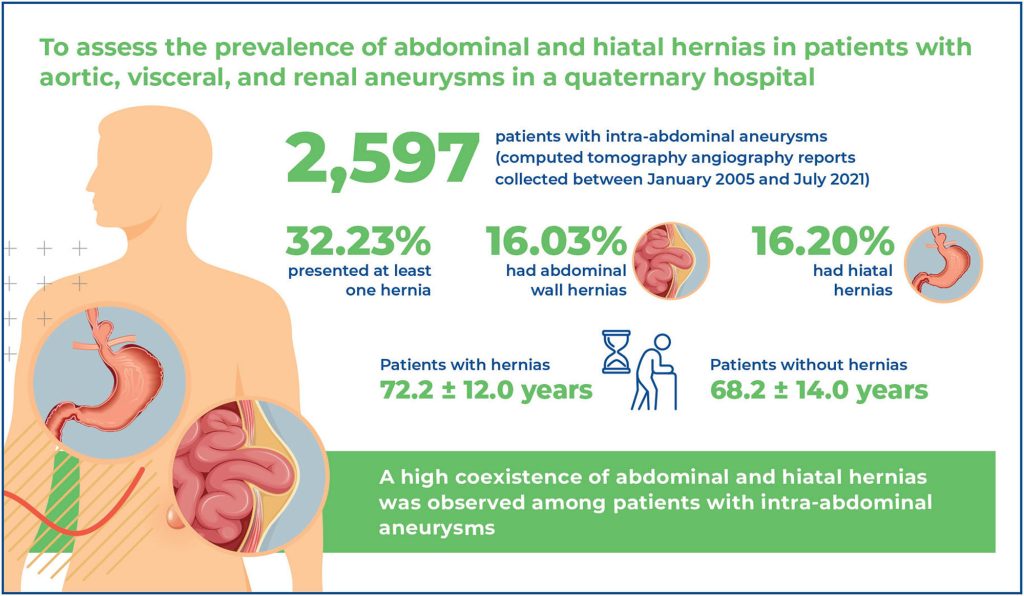
This study aimed to assess the prevalence of abdominal and hiatal hernias in patients with aortic, visceral, and renal aneurysms in a quaternary hospital.
Methods:
Computed tomography angiography reports from 2,597 patients with intra-abdominal aneurysms, collected between January 2005 and July 2021 at a private hospital in São Paulo, Brazil, were analyzed. The variables of interest were analyzed descriptively, and inferential statistics (chi-square test and Student’s t-test) were applied to explore relationships between sex, age, number of vessels with aneurysms, and number of hernias identified by computed tomography angiography.
Results:
Of 2,597 patients with abdominal aneurysms, 837 (32.23%) presented with at least one hernia. Among them, 416 patients (16.03%) had abdominal wall hernias, while 421 (16.20%) had hiatal hernias. Patients with hernias were significantly older (72.2±12.0 years; p<0.001) than patients without hernias (68.2±14.0 years); there were no significant age differences between sexes (p=0.714). Hiatal hernias had a high prevalence (50.3%) among both aortic and visceral aneurysms, particularly amnong those with hepatic artery (42.91%) and celiac trunk aneurysms (41.82%).
Conclusion:
A high coexistence of abdominal and hiatal hernias was observed among patients with intra-abdominal aneurysms. These findings highlight a statistical association and should not be interpreted as indicating a causal relationship or as a risk-stratification tool in the absence of prospective, controlled studies.
[…]