03/Aug/2026
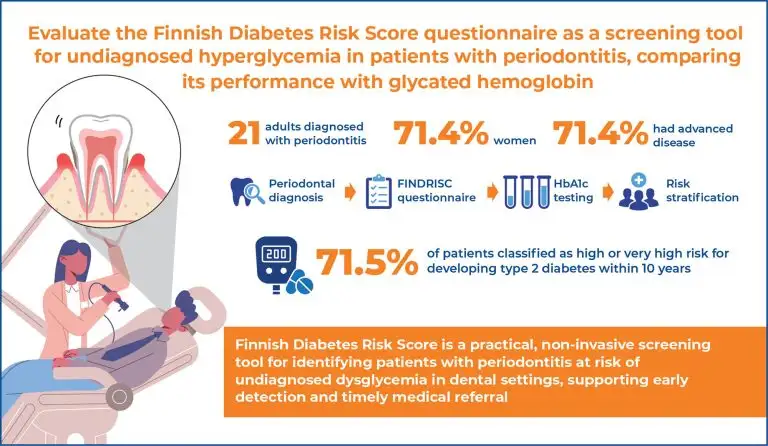
Screening for undiagnosed hyperglycemia in patients with periodontitis: a cross-sectional study
einstein (São Paulo). 03/Aug/2026;24(spe3):eAO2397.
View Article03/Aug/2026
Screening for undiagnosed hyperglycemia in patients with periodontitis: a cross-sectional study
DOI: 10.31744/einstein_journal/2026AO2397
Highlights ■ Finnish Diabetes Risk Score identified high diabetes risk in most patients with periodontitis. ■ High or very high T2DM risk was observed in 71.5% of participants. ■ Finnish Diabetes Risk Score ≥12 was associated with dysglycemia and severe periodontitis. ■ Dental clinics may help detect undiagnosed hyperglycemia early. ABSTRACT Objective: We evaluated the potential of the Finnish Diabetes Risk Score questionnaire to screen for undiagnosed hyperglycemia in patients with periodontitis, comparing its performance with that of glycated hemoglobin […]
Keywords: Diabetes mellitus; Diagnosis; Glycated hemoglobin; Hyperglycemia; Periodontal diseases; Periodontitis; Risk assessment; Surveys and questionnaires
01/Jul/2026
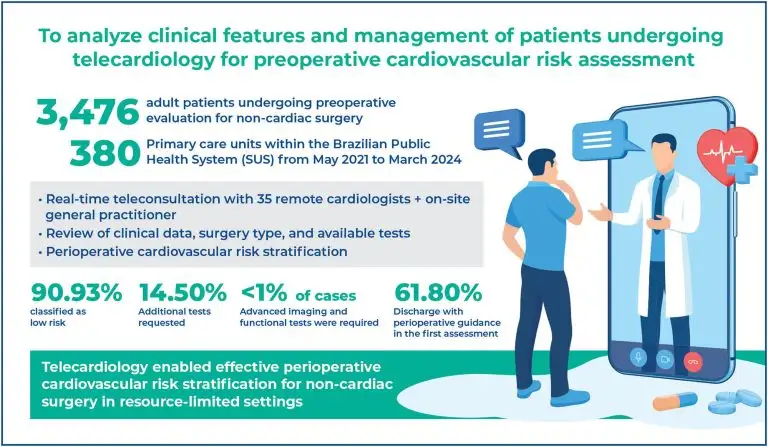
Telecardiology assessment of patients undergoing non-cardiac surgery
DOI: 10.31744/einstein_journal/2026AO1949
Highlights ■ Telecardiology enabled perioperative cardiovascular risk assessment for non-cardiac surgery. ■ Most patients were safely classified as low cardiovascular risk at first consultation. ■ Additional testing and urgent referrals were rarely required. ■ Remote assessment expanded access to cardiology care in underserved regions. ABSTRACT Objective: This study aimed to investigate the clinical characteristics and management strategies of patients referred for telecardiology consultations, specifically for preoperative cardiovascular risk assessment. Methods: A retrospective observational study at a Telemedicine Center in São […]
Keywords: Perioperative care; Risk assessment; Surgical clearance; Telecardiology; Telemedicine
01/Oct/2017
Emergency Severity Index: accuracy in risk classification
DOI: 10.1590/S1679-45082017AO3964
ABSTRACT Objective: To verify agreement between estimative of predicted resources using the adapted Emergency Severity Index and the real amount of resources used by patients. To analyze the variables number of years since graduation, years of work experience and years of experience in emergency services especially with accurate anticipation of resources need. Methods: This retrospective analytical study with a quantitative approach included 538 medical records of patients assisted by 11 triage nurses. Data collected were related to assistances carried out […]
Keywords: Emergency medical services; Emergency nursing; Protocols; Risk assessment; Triage
01/Jul/2015
Agreement in cardiovascular risk rating based on anthropometric parameters
DOI: 10.1590/S1679-45082015AO3349
Objective To investigate the agreement in evaluation of risk of developing cardiovascular diseases based on anthropometric parameters in young adults. Methods The study included 406 students, measuring weight, height, and waist and neck circumferences. Waist-to-height ratio and the conicity index. The kappa coefficient was used to assess agreement in risk classification for cardiovascular diseases. The positive and negative specific agreement values were calculated as well. The Pearson chi-square (χ2) test was used to assess associations between categorical variables (p
Keywords: Anthropometry; Body weights and measures; Cardiovascular diseases; Risk assessment; Sex
19/Sep/2012
Assessment of cardiovascular risk of patients with arterial hypertension of a public health unit
DOI: 10.1590/S1679-45082012000100008
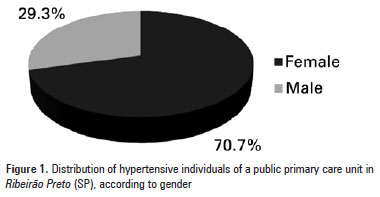
OBJECTIVE: To assess the cardiovascular risk, using the Framingham risk score, in a sample of hypertensive individuals coming from a public primary care unit. METHODS: The caseload comprised hypertensive individuals according to criteria established by the JNC VII, 2003, of 2003, among 1601 patients followed up in 1999, at the Cardiology and Arterial Hypertension Outpatients Clinic of the Teaching Primary Care Unit, at the Faculdade de Medicina de Ribeirão Preto, Universidade de São Paulo. The patients were selected by draw, […]
Keywords: Cardiovascular diseases; Dyslipidemias; Health centers; Hypercholesterolemia; Hypertension; Primary prevention; Risk assessment; Smoking