14/Aug/2026
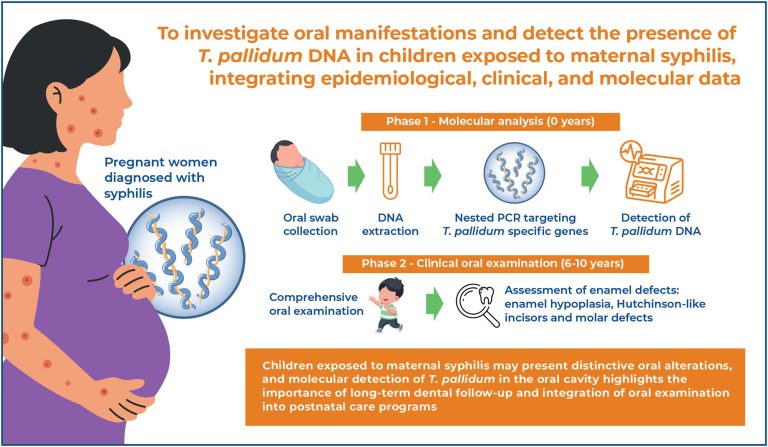
Congenital syphilis and oral involvement: Treponema pallidum detection and oral development in exposed children
einstein (São Paulo). 14/Aug/2026;24(spe3):eAO2472.
View Article14/Aug/2026
Congenital syphilis and oral involvement: Treponema pallidum detection and oral development in exposed children
DOI: 10.31744/einstein_journal/2026AO2472
Highlights ■ Oral swabs were collected at birth and analyzed by nested polymerase chain reaction for T. pallidum DNA. ■ A high prevalence of enamel hypoplasia, Hutchinson-like incisors, and molar defects was observed at 6-10 years of age. ■ Molecular detection in oral samples suggests possible persistence of treponemal DNA or residual genetic material. ■ Integrating oral examinations into postnatal care programs may support long-term monitoring of children exposed to maternal syphilis. ABSTRACT Objective: To investigate oral manifestations and the […]
Keywords: congenital; Infant; Newborn; Oral manifestations; Polymerase chain reaction; Syphilis; Treponema pallidum
22/Mar/2022
Fibroblast growth factor receptor 3 gene (FGFR3) mutations in high-grade muscle-invasive urothelial bladder cancer in a Brazilian population: evaluation and prevalence
einstein (São Paulo). 22/Mar/2022;20:eAO6450.
View Article22/Mar/2022
Fibroblast growth factor receptor 3 gene (FGFR3) mutations in high-grade muscle-invasive urothelial bladder cancer in a Brazilian population: evaluation and prevalence
DOI: 10.31744/einstein_journal/2022AO6450
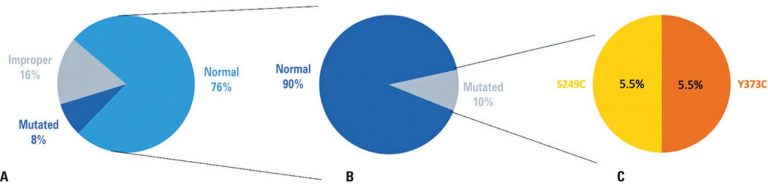
ABSTRACT Objective To understand the feasibility of FGFR3 tests in the Brazilian public health context, and to sample the mutational burden of this receptor in high-grade muscle invasive bladder cancer. Methods A total of 31 patients with high-grade muscle-invasive bladder cancer were included in the present study. Either transurethral resection of bladder tumor or radical cystectomy specimens were analyzed. Formalin-fixed paraffin-embedded tissue blocks were sectioned, hematoxylin and eosin stained, and histologic sections were reviewed. Total RNA was extracted using the […]
Keywords: Carcinoma, transitional cell; DNA; Mutation; Polymerase chain reaction; Receptor, fibroblast growth factor, type 3; Sequence analysis, DNA; Urinary bladder neoplasms
07/Mar/2022
COVID-19 containment management strategies in a nursing home
DOI: 10.31744/einstein_journal/2022AO6175
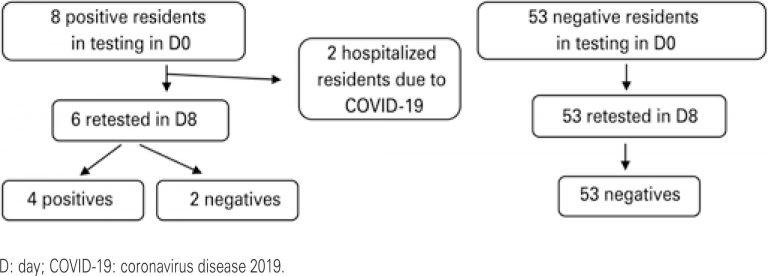
ABSTRACT Objective: To describe the first COVID-19 pandemic at Casa Ondina Lobo, a philanthropic nursing home in São Paulo city, and the containment measures against the pandemic that proved to be effective. Methods: Several preventive measures were taken before and during the pandemic, with emphasis on universal testing by reverse transcription polymerase chain reaction for COVID-19. All residents and employees were tested twice in a D9 period. Results: Among the 62 residents and 55 employees, in both testing, eight residents […]
Keywords: Carrier state; Communicable disease control; Coronavirus infections; COVID-19; Homes for the aged; Infection control; Nursing homes; Polymerase chain reaction; SARS-CoV-2
04/Sep/2017
Preimplantation genetic diagnosis associated to Duchenne muscular dystrophy
DOI: 10.1590/S1679-45082017RC3994
ABSTRACT Duchenne muscular dystrophy is the most common muscle disease found in male children. Currently, there is no effective therapy available for Duchenne muscular dystrophy patients. Therefore, it is essential to make a prenatal diagnosis and provide genetic counseling to reduce the birth of such boys. We report a case of preimplantation genetic diagnosis associated with Duchenne muscular dystrophy. The couple E.P.R., 38-year-old, symptomatic patient heterozygous for a 2 to 47 exon deletion mutation in DMD gene and G.T.S., 39-year-old, […]
Keywords: Case reports; Comparative genomic hybridization; Muscular dystrophy, Duchenne; Polymerase chain reaction; Prenatal care