einstein (São Paulo). 14/Aug/2026;24(spe3):eAO2330.
Quality of referral letters in oral medicine: a two-year study in a Brazilian public dental specialty center

DOI: 10.31744/einstein_journal/2026AO2330
Highlights
■ Most referral letters lacked essential clinical information.
■ Lesion size and limits were rarely documented in referrals.
■ High-risk oral lesions often had incomplete documentation.
■ Standardized templates may improve early oral cancer detection.
ABSTRACT
Objective:
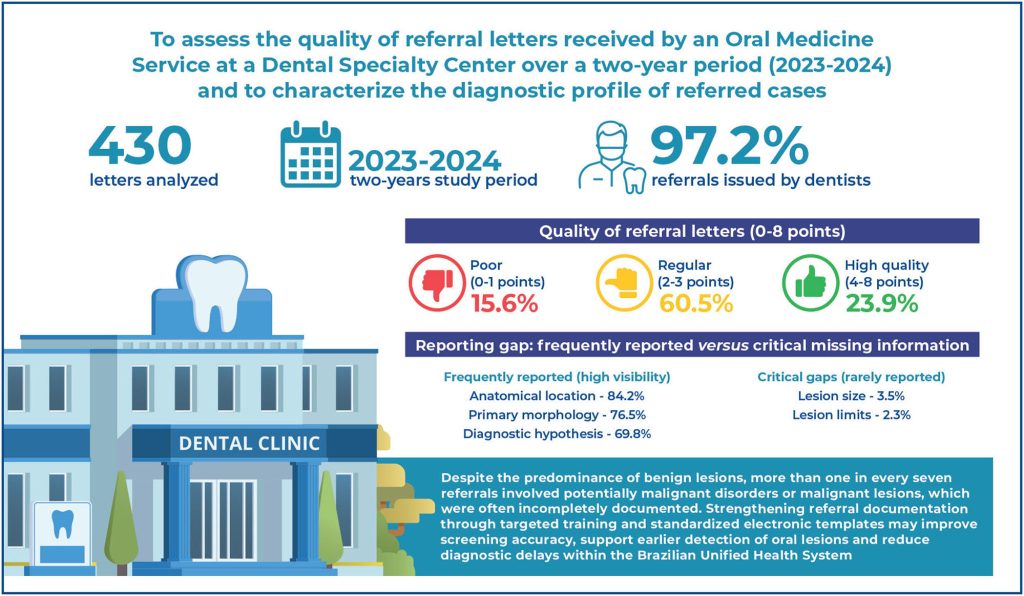
In the Brazilian public health system, referral letters, issued by general dentists and physicians who perform initial clinical assessments, is the main source of information in arriving at a final diagnosis. However, the consistency and completeness of the referral letters remain poorly explored. Therefore, we assessed the quality of referral letters received by an oral medicine service at a dental specialty center over a 2-year period (2023–2024) and characterized the diagnostic profile of referred cases.
Methods:
This census-based retrospective cross-sectional study analyzed 430 referral letters using 8 predefined criteria (0–8 points) on lesion characteristics, clinical history, and diagnostic hypothesis. The referral letters were classified as poor (0–1), regular (2–3), good (4–6), or excellent (7–8).
Results:
All referrals were from public services; 47.0% were issued in 2023 and 53.0% in 2024. Referrals to dentists accounted for 97.2% of the referrals. Most letters were rated as regular (60.5%) or good (23.0%), while 15.6% were classified as poor and only 0.9% as excellent. Frequently reported descriptors included lesion location (84.2%) and primary morphology (76.5%). Clinically relevant details such as symptomatology (22.8%), time of evolution (16.0%), lesion size (3.5%), and limits (2.3%) were mostly absent. Diagnoses included benign lesions (71.9%), potentially malignant disorders (10.7%), normality variations (6.3%), and malignant lesions (3.7%); 7.4% of the referrals had no diagnosis. Referral quality scores differed significantly across diagnostic categories (p=0.0076), with lower scores observed in cases without a final diagnosis.
Conclusions:
Despite the predominance of benign lesions, more than one in every seven referrals, which were often incompletely documented, involved potentially malignant disorders or malignant lesions. Strengthening referral documentation through targeted training and standardized electronic templates may improve screening accuracy, support the earlier detection of oral lesions, and reduce diagnostic delays within the Brazilian unified health system.
[…]