einstein (São Paulo). 28/May/2026;24:eAO1866.
Medical students’ perception of the OSCE: development and validation of an instrument to assess formative and summative modalities

DOI: 10.31744/einstein_journal/2026AO1866
Highlights
■ Instrument developed to assess medical students’ perceptions of OSCEs.
■ Evidence of strong validity and excellent internal consistency.
■ Formative and summative OSCE modalities were also assessed.
■ Tool supports educational assessment and feedback in medical education.
ABSTRACT
Objective:
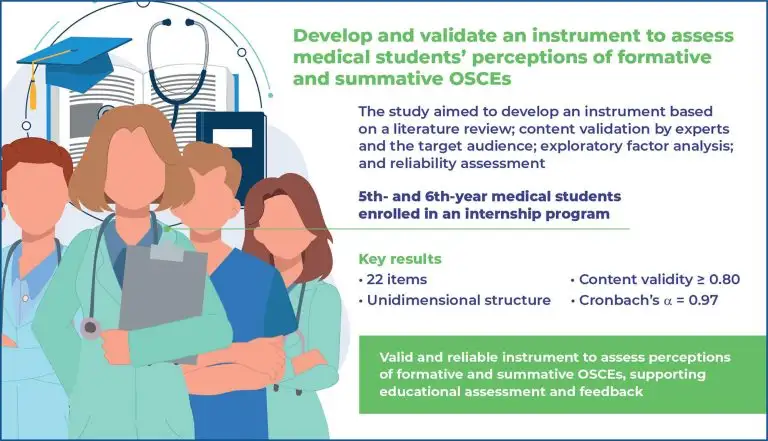
To develop, validate, and apply an instrument aimed at assessing medical students’ perceptions of the impact of an Objective Structured Clinical Examination (OSCE), both in its peer-based formative and traditional summative modalities, on clinical learning.
Methods:
This study used a mixed quantitative and qualitative approach. The instrument development was preceded by a literature review. Content validation was conducted by specialists through an OSCE using Pasquali’s psychometric criteria (clarity, relevance, and pertinence). A pre-test with students enabled semantic and structural adjustments through triangulation with experts. For reliability, the Content Validity Coefficient and exploratory factor analysis were applied to the responses of fifth- and sixth-year students.
Results:
The final instrument included 22 items in three sections. All items had content validity coefficients equal to or greater than 0.80. The expert evaluations yielded coefficients of 0.924 for clarity, 0.925 for pertinence, and 0.945 for relevance. Target audience validation showed similarly high scores. Exploratory factor analysis of 96 medical students confirmed a unidimensional structure for both the formative and summative versions of the OSCE. The Kaiser-Meyer-Olkin index ranged from 0.91 to 0.93, and the Bartlett’s test was significant (p<0.001). Factor loadings ranged from 0.75 to 0.98, explaining 77% of the variance. The internal consistency was excellent (Cronbach’s alpha=0.97).
Conclusion:
This study developed a validated, reliable, and innovative instrument to assess students’ perceptions of the OSCE in health education.
[…]