einstein (São Paulo). 04/May/2026;24:eAO1615.
High-mobility group box 1 protein, histone H3 and histone H4 are not associated with peripheral hypoperfusion in sepsis: a retrospective cohort study
Bruna Cassia Dal , Ana Carolina de , Fernanda do Carmo De , Luis Gustavo , Dalila Luciola , Luiz Eduardo Nunes , Igor Alexandre Cortês de

DOI: 10.31744/einstein_journal/2026AO1615
Highlights
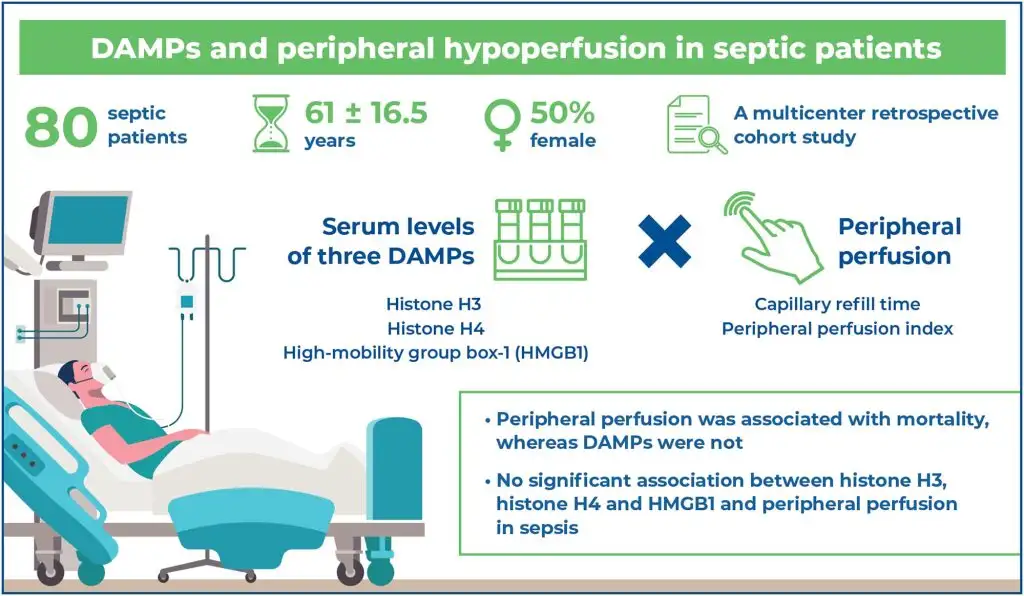
■ This study aimed to evaluate the association between damage-associated molecular patterns and peripheral hypoperfusion in sepsis.
■ Surviving patients showed better peripheral perfusion than non-survivors.
■ No significant association was observed between mortality and serum levels of the evaluated damage-associated molecular patterns.
■ Damage-associated molecular patterns levels did not differ between patients with reduced or normal peripheral perfusion.
■ Surviving patients showed better peripheral perfusion than non-survivors.
■ No significant association was observed between mortality and serum levels of the evaluated damage-associated molecular patterns.
■ Damage-associated molecular patterns levels did not differ between patients with reduced or normal peripheral perfusion.
ABSTRACT
Objective:
The causal mechanisms of peripheral hypoperfusion in sepsis have not yet been fully elucidated. Therefore, this study aimed to investigate whether peripheral hypoperfusion in septic patients is associated with serum levels of damage-associated molecular patterns.
Methods:
A retrospective cohort study was conducted to compare serum levels of damage-associated molecular patterns – histone H3, histone H4, and high-mobility group box-1 protein (HMGB1) – with markers of tissue hypoperfusion – the peripheral perfusion index and the capillary refill time, using a single measurement obtained within the first 24 hours after sepsis diagnosis in critically ill patients from two Brazilian hospitals.
Results:
Eighty patients were included in the study. Approximately half of the patients showed persistent peripheral hypoperfusion as determined by at least one of the techniques used. Surviving patients had better capillary refill time [2 (2-4) versus 4 (2-5), p=0.01] and perfusion index [1.9 (0.98-4.95) versus 0.54 (0.32-0.87) p<0.0001] compared with non-survivors. None of the evaluated damage-associated molecular patterns distinguished between survivors and non-survivors. In addition, damage-associated molecular patterns were not associated with perfusion index (versus HMGB1, p=0.13; versus H3, p=0.51 and versus H4, p=0.25) or capillary refill time (versus HMGB1, p=0.29; versus H3, p=0.60 and versus H4, p=0.92).
Conclusion:
In septic patients evaluated in this retrospective cohort study, no statistically significant association was found between the levels of histones H3, H4, and HMGB1 protein, tissue hypoperfusion, and mortality.
[…]
High-mobility group box 1 protein, histone H3 and histone H4 are not associated with peripheral hypoperfusion in sepsis: a retrospective cohort study
Keywords: Sepsis; Alarmins; HMGB1 protein; Histones; Perfusion index; Microcirculation