11 results
14/Aug/2026
14/Aug/2026
DOI: 10.31744/einstein_journal/2026AO2528
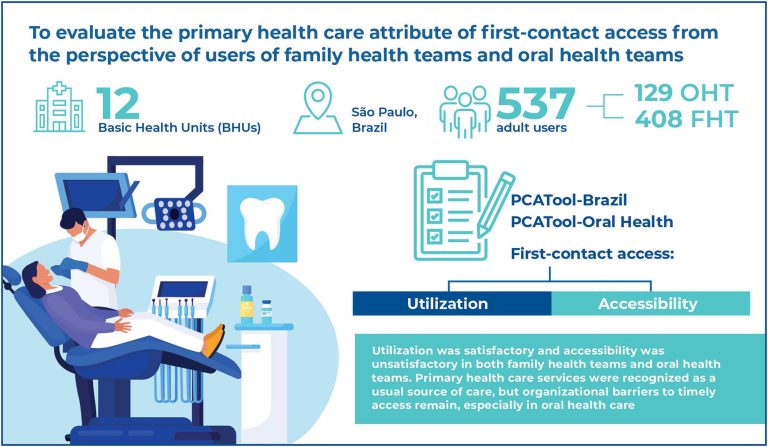
Highlights ■ Utilization scores were higher than accessibility scores in both family health teams and oral health teams. ■ The performance of accessibility was predominantly low in both service modalities. ■ Among oral health teams users, few differences were observed across participant characteristics. ■ Utilization was higher among older, vulnerable, and chronically ill family health teams users. ABSTRACT Objective: In this study, we aimed to evaluate the primary health care attribute of first-contact access from the perspective of users of […]
Keywords: Health Services Accessibility; Health services research; Oral health; Primary Health Care; Quality of Health Care
03/Aug/2026
03/Aug/2026
DOI: 10.31744/einstein_journal/2026AO2495
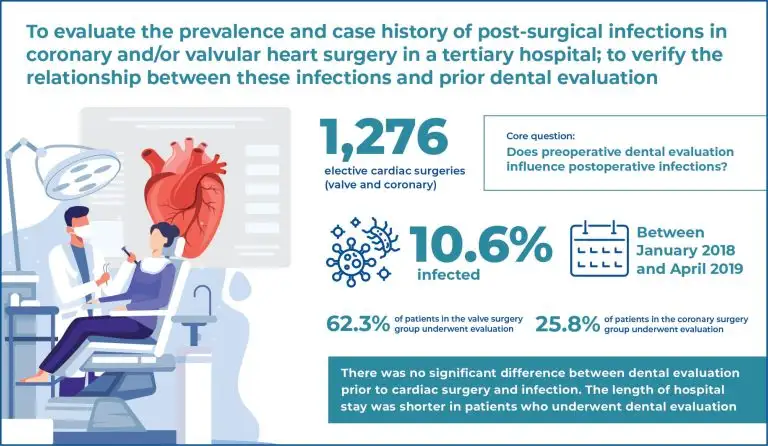
Highlights ■ The post-surgical infection rate after elective cardiac surgery was 10.6%. ■ Preoperative dental assessment was not significantly associated with reduced post-surgical infection. ■ Preoperative dental assessment was associated with a shorter hospital stay (p<0.05). ■ Overall, 89.8% of evaluated patients remained infection-free, indicating a favorable trend. ABSTRACT Objective: To evaluate the prevalence and clinical characteristics of post-surgical infections after coronary and/or valvular heart surgery at a tertiary hospital and to examine the relationship between these infections and prior […]
Keywords: Cardiovascular surgical procedures; Dental care; Diagnosis, oral; Infections; Oral health; Risk Factors; Thoracic surgical procedures
23/Jul/2025
23/Jul/2025
DOI: 10.31744/einstein_journal/2025AO1476
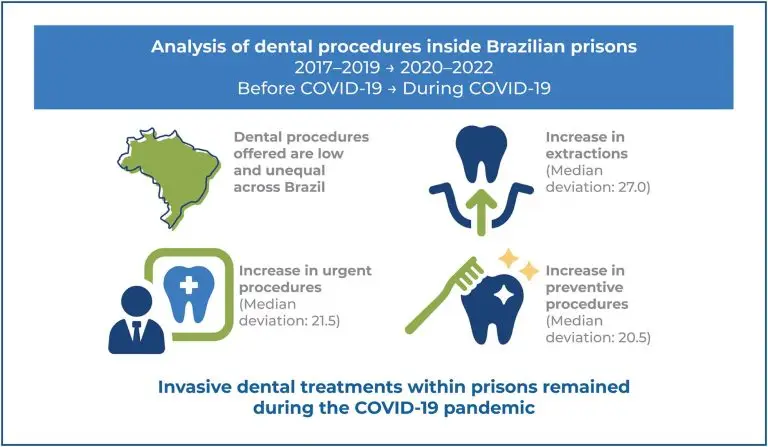
Highlights ■ The quantity of dental procedures in prisons differs across Brazilian regions. ■ Prisoners’ access to dental procedures was limited even prior to the pandemic. ■ Preventive, urgent, and dental extraction procedures exhibited increases. ■ Restorative and periodontic procedures did not exhibit statistically significant changes. ABSTRACT Objective: This study compared the productivity of prison oral health teams during the COVID-19 crisis (2020–2022) with the previous three-year period (2017–2019) to identify the number and type of dental procedures performed. Methods: […]
Keywords: Dentistry; Health Services; Oral health; Prisoners
15/Sep/2023
DOI: 10.31744/einstein_journal/2023AO0195
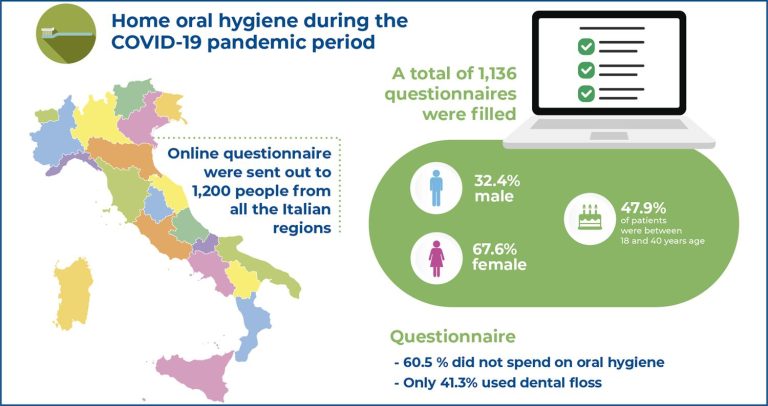
Highlights Dental and tongue hygiene are key to maintaining systemic health. The questionnaire was sent by e-mail to 1,136 male and female patients throughout Italy. Demonstrate and understand whether patients during the pandemic cleaned and spent time cleaning and maintaining their teeth and tongue hygiene. The questionnaire testifies to the fact that it is not the time but the patient’s compliance and motivation that makes the difference. INTRODUCTION Oral hygiene techniques must be performed not only to maintain oral […]
Keywords: Coronavirus infections; COVID-19; Epidemiologic studies; Oral health; Oral hygiene; Patient compliance; Surveys and questionnaires
31/Jul/2023
31/Jul/2023
DOI: 10.31744/einstein_journal/2023AO0103
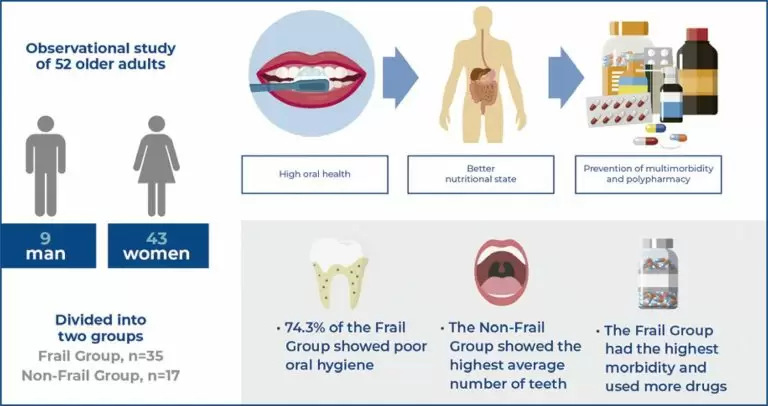
Highlights Better oral hygiene improves aspects of social interaction. Care of teeth and dentures is beneficial for chewing and swallowing. Poor oral health is clearly related to frailty. ABSTRACT Objective This study aimed to correlate oral and general health in frail and non-frail older adults. Methods This observational study included 52 older adults, of whom 35 were frail (Frail Group), and 17 were non-frail (Non-Frail Group), according to Fried’s self-reported test addressing oral health variables, number of systemic diseases, and […]
Keywords: Aging; Frail elderly; Frailty; Health status; Oral health; Self report; Surveys and questionnaires
19/Apr/2018
DOI: 10.1590/S1679-45082018AO4079
ABSTRACT Objective To evaluate knowledge on oral health and associated sociodemographic factors in pregnant women. Methods A cross-sectional study with a sample of 195 pregnant women seen at the Primary Care Unit Paraisópolis I, in São Paulo (SP), Brazil. For statistical analysis, χ2 or Fisher’s exact test and multiple logistic regression were used. A significance level of 5% was used in all analyses. Results Schooling level equal to or greater than 8 years and having one or two children were […]
Keywords: Oral health; Pregnant Women; Prenatal care; Primary Health Care; Social conditions
01/Apr/2016
DOI: 10.1590/S1679-45082016AO3616
ABSTRACT Objective To analyze the perception of mothers about oral health of their children, as well as to check the influence of demographic variables, perception and preventive practice in oral health of mothers regarding guidance received during pregnancy. Methods Quantitative and cross-sectional field study, with a non-probability sample formed by all mothers who attended the primary healthcare unit of Ijuí (RS), Brazil, from January to July 2014, comprising a sample of 79 women. Self-applied questionnaires were given to these mothers. […]
Keywords: Oral health; Oral hygiene; Perception; Pregnancy
01/Jul/2014
DOI: 10.1590/S1679-45082014AO3000
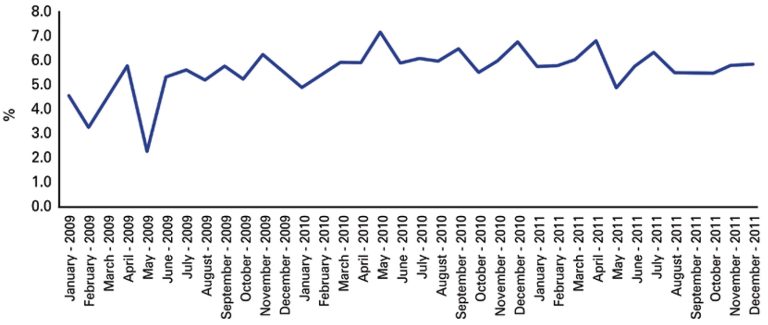
Objective To evaluate the evolution of indicators after the implementation of 21 Oral Healthcare Teams in the Family Health Strategy. Methods We used data from outpatient services of Oral Healthcare Teams to evaluate efficiency, access, percentage of absences and emergencies of oral healthcare professionals who worked in the partnership between the Sociedade Beneficente Israelita Brasileira Hospital Albert Einstein and the Secretaria Municipal de Saúde de São Paulo, during the period 2009-2011. Results Percentages of emergencies, income, and access showed a […]
Keywords: Absenteeism; Delivery of healthcare; Family health; Health Services Accessibility; Oral health
09/Apr/2013
DOI: 10.1590/S1679-45082013000100017
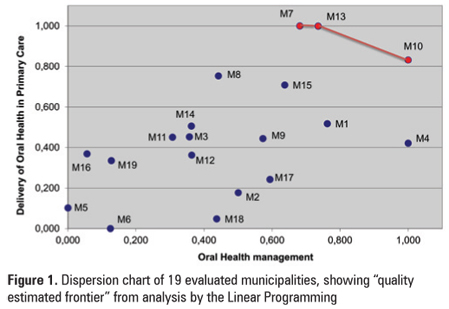
OBJECTIVE: To show the use of Linear Programming to evaluate the performance of Oral Health in Primary Care. METHODS: This study used data from 19 municipalities of Santa Catarina city that participated of the state evaluation in 2009 and have more than 50,000 habitants. A total of 40 indicators were evaluated, calculated using the Microsoft Excel 2007, and converted to the interval [0, 1] in ascending order (one indicating the best situation and zero indicating the worst situation). Applying the […]
Keywords: Employee performance appraisal; Health Evaluation; Oral health; Primary Health Care; Programming, Linear
01/Oct/2011
DOI: 10.1590/S1679-45082011AO2184
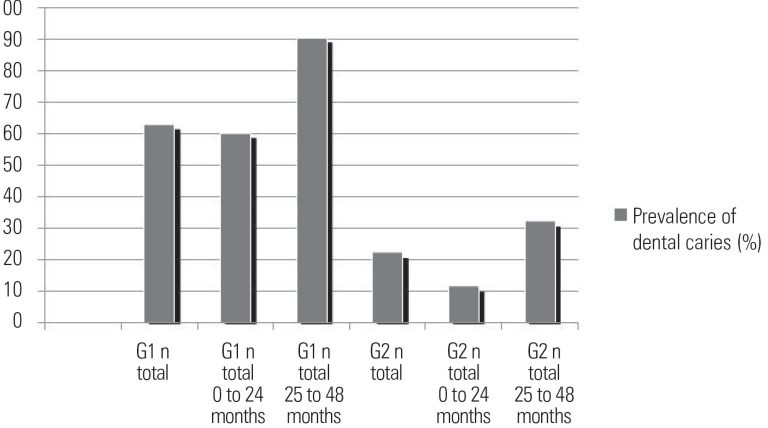
ABSTRACT Objective: To assess the impact of the “Dentistry for Infants” early dental care program run by Jacareí County (SP) by comparing the caries of individuals participating and not participating in this program. Methods: In total, 300 children between 0 and 48 months old were assessed in the following two groups: infants not participating in the program (G1, n = 100) and infants participating in the program (G2, n = 200). Each group was further divided according to age in […]
Keywords: Child; Dental caries/epidemiology; Dental caries/prevention & control; Infant; Oral health; Pediatric dentistry