einstein (São Paulo). 01/Jul/2026;24:eAO1949.
Telecardiology assessment of patients undergoing non-cardiac surgery

DOI: 10.31744/einstein_journal/2026AO1949
Highlights
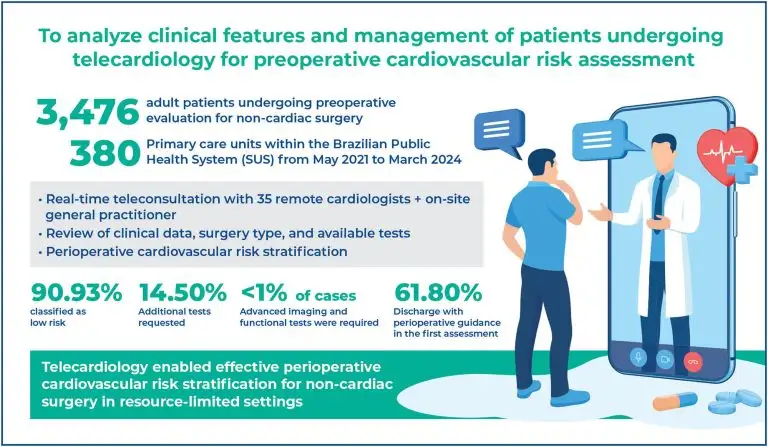
■ Telecardiology enabled perioperative cardiovascular risk assessment for non-cardiac surgery.
■ Most patients were safely classified as low cardiovascular risk at first consultation.
■ Additional testing and urgent referrals were rarely required.
■ Remote assessment expanded access to cardiology care in underserved regions.
ABSTRACT
Objective:
This study aimed to investigate the clinical characteristics and management strategies of patients referred for telecardiology consultations, specifically for preoperative cardiovascular risk assessment.
Methods:
A retrospective observational study at a Telemedicine Center in São Paulo, Brazil, reference for 380 primary health care facilities was performed from May 2021 to March 2024. Adults aged >18 years were included in this study. Thirty-five cardiologists conducted real-time teleconsultations with general practitioners and reviewed patient data, type of surgery, clinical details, complementary examinations, and consultation outcomes. Descriptive statistics were used for analyses.
Results:
A total of 3,476 patients (63% female, mean age 52.1 years) were evaluated. Among them, 3,307 (95.1%) were asymptomatic, 1,241 (35.70%) had hypertension, and 1,312 (48.4%) had a sedentary lifestyle. The most frequently performed surgical procedure was intra-abdominal surgery, performed in 1,665 (47.9%) cases. Risk stratification categorized 3,161 (90.93%) patients as low risk, 90 (2.59%) as intermediate risk, and 36 (1.03%) as high risk. Ancillary testing was requested in 504 (14.50%) patients, with laboratory evaluations conducted in 304 (8.74%) and electrocardiograms in 234 (6.73%). Telecardiology interventions included antihypertensive medications in 192 (5.52%) patients, statin prescriptions in 88 (2.53%) patients, and guidance for postoperative monitoring in 98 (2.81%) patients.
Conclusion:
This exploratory study demonstrated that most cardiologists successfully performed perioperative risk stratification via telemedicine during initial consultation, targeting a predominantly low-risk population.
[…]