einstein (São Paulo). 25/Jun/2026;24:eAO2160.
Whole-genome sequencing in Brazilian patients with neurofibromatosis type 1, including novel variants, incidental findings, and dual diagnoses

DOI: 10.31744/einstein_journal/2026AO2160
Highlights
■ This is the largest cohort of individuals with NF1 investigated through whole-genome sequencing.
■ Molecular data contributed to the representation of the Brazilian population in genomic research.
■ Novel variants in the NF1 gene have been described, including c.3372del, c.7299del, and c.7457_7457+2del.
■ The first report of spinocerebellar ataxia type 19 in Brazil is also presented.
ABSTRACT
Objective:
To describe clinical and molecular aspects of a cohort of Brazilian individuals with neurofibromatosis type 1, a neurocutaneous disorder associated with a predisposition to tumors and inter- and intrafamilial variable expressivity.
Methods:
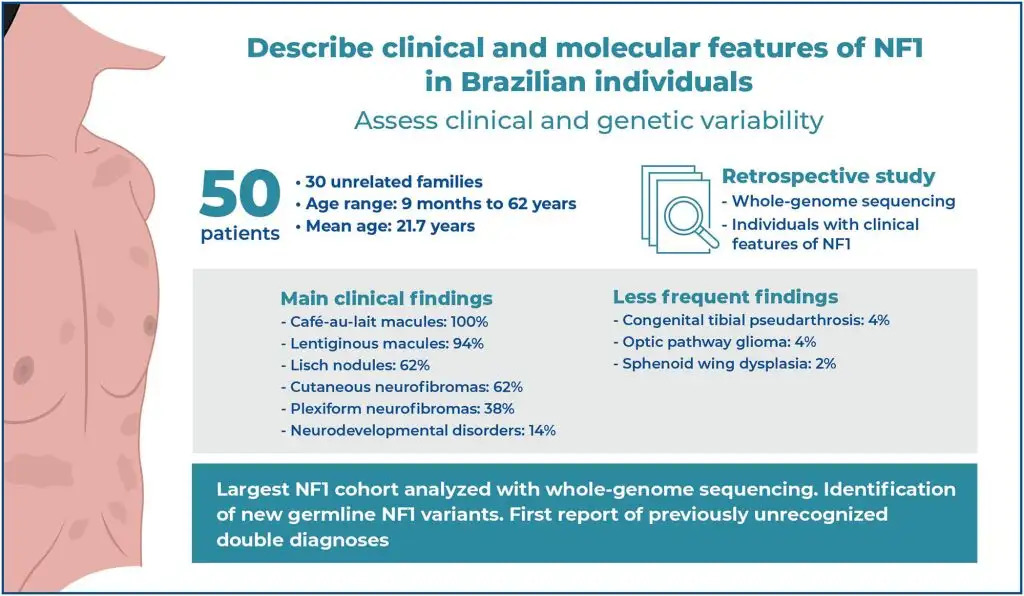
We conducted a retrospective study of 50 patients from 30 unrelated families, with features of Neurofibromatosis type 1, who underwent clinical evaluation and whole genome sequencing.
Results:
Patient ages ranged from 9 months to 62 years (mean 21.7 years). The most frequent manifestations were café-au-lait (100%), lentiginous macules (94%), Lisch nodules (62%), cutaneous (62%), and plexiform (38%) neurofibromas. Other findings included neurodevelopmental disorders (14%), congenital pseudarthrosis of the tibia (4%), optic pathway glioma (4%), and sphenoid wing dysplasia (2%). Eight individuals presented with tumors other than neurofibromas, including two with malignant peripheral nerve sheath tumors, two with breast cancer, and one each with a dysembryoplastic neuroepithelial tumor, cholangiocarcinoma, pilocytic astrocytoma, and basal cell carcinoma. All probands, except one, tested positive for pathogenic or likely pathogenic variants, of which three (11.1%) were novel (c.3372del, c.7299del, and c.7457_7457+2del), three were recurrent within this series (c.3826C>T, c.5902C>T, and c.6855C>A), and the others were private. Two families (6.6%) presented incidental findings, one in BRCA1 and the other in TMEM127. Three individuals (6.5%) had a second molecular diagnosis: one each with spinocerebellar ataxia type 19, primary ciliary dyskinesia type 3, and XYY syndrome.
Conclusion:
This study presents the largest cohort of Brazilian individuals with neurofibromatosis type 1 to utilize whole-genome sequencing, identifying three novel germline NF1 variants and two previously unreported double diagnoses.
[…]