einstein (São Paulo). 08/Jun/2026;24:eGS1136.
Rigid cystoscopy versus flexible outpatient cystoscopy: the economic cost behind the epidemiological and social impact

DOI: 10.31744/einstein_journal/2026GS1136
Highlights
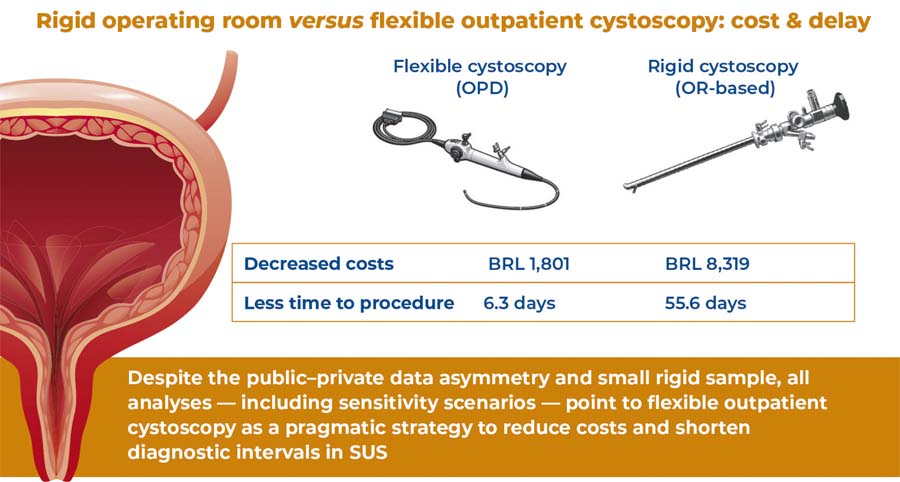
■ Rigid cystoscopy requires greater resources and generates higher overall costs.
■ Flexible cystoscopy substantially shortens the waiting time for diagnosis.
■ Cost advantages of flexible cystoscopy persist even under conservative assumptions.
ABSTRACT
Introduction:
The Brazilian Public Health System predominantly performs cystoscopy in hospitals using rigid cystoscopes in operating room settings. This approach results in high operational costs and scheduling delays associated with hospital admission and preoperative protocols. Flexible cystoscopy can be performed in an outpatient setting and may substantially reduce both costs and waiting times.
Objective:
To compare the costs and waiting times associated with rigid and flexible cystoscopy in São Paulo, Brazil.
Methods:
A retrospective review at a municipal hospital in Brazil identified patients who underwent diagnostic rigid cystoscopy. The analysis estimated the cost of the procedure and the time from indication to examination. Because no public hospital performed flexible cystoscopy during the study period, fees from private hospitals were collected as a proxy and incorporated into a one-way sensitivity analysis.
Results:
The mean cost per rigid cystoscopy reached BRL 8,319.45 (US$1,618.82), ranging from BRL 6,187.10 (US$1,203.90) to BRL 10,512.34 (US$2,045.52). Costs were higher when biopsy occurred (mean BRL 9,744.20) and lower when biopsy was not performed (mean BRL 6,609.75). Fees for flexible cystoscopy ranged from BRL 1,523.81 (US$296.51) to BRL 2,300.00 (US$447.54), with a mean value of BRL 1,800.60 (US$350.37). The mean interval from indication to procedure was 55.64 days for rigid cystoscopy compared with 6.34 days in centers that perform flexible cystoscopy. In sensitivity analysis, even when public-sector flexible cystoscopy costs reached 1.5-3.0× the private fee (BRL 2,701-5,402), the procedure remained approximately 35-68% less expensive than rigid cystoscopy.
Conclusion:
Management of bladder cancer imposes a substantial economic burden on Brazilian Public Health System. Despite the asymmetry between public and private data sources, these findings support adoption of outpatient flexible cystoscopy to accelerate diagnosis and reduce costs, with important implications for health policy.
[…]