einstein (São Paulo). 16/Mar/2026;24:eAO1455.
Impact of peripheral muscle strength on extubation success after cardiac surgery

DOI: 10.31744/einstein_journal/2026AO1455
Highlights
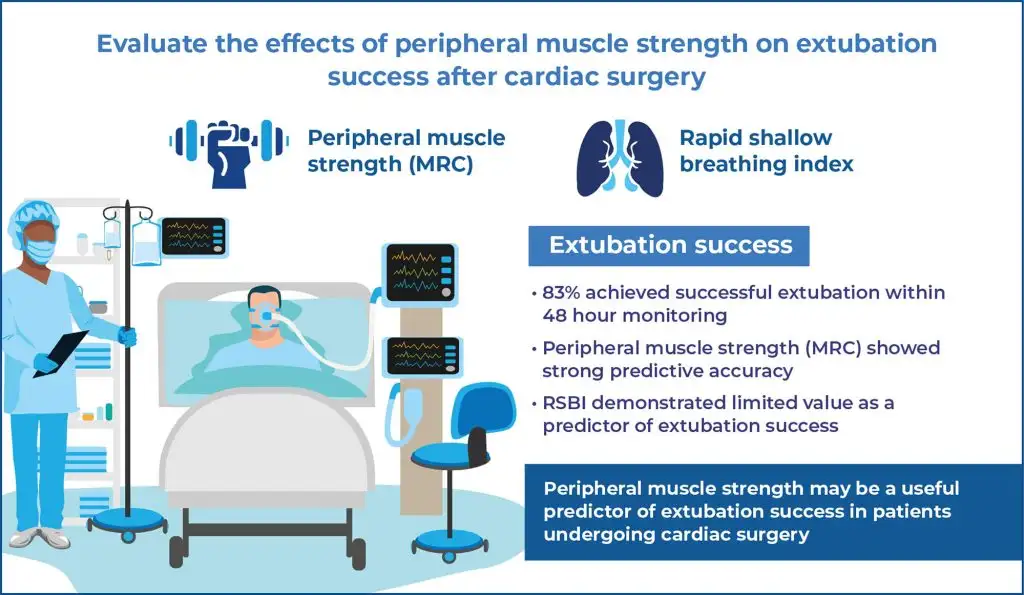
■ Peripheral muscle strength outperformed the Rapid Shallow Breathing Index in predicting extubation success.
■ Extubation was successful in 83% patients within a 48-hour monitoring period.
■ Peripheral muscle strength showed strong predictive accuracy.
■ Rapid Shallow Breathing Index demonstrated limited value as a predictor of extubation success.
ABSTRACT
Objective:
To evaluate the effects of peripheral muscle strength on extubation success after cardiac surgery.
Methods:
In this prospective cohort study, peripheral muscle strength and Rapid Shallow Breathing Index were assessed at 30 and 10 minutes during a spontaneous breathing trial. Patients were extubated and monitored for 48 hours to verify the success or failure of extubation, and preoperative variables were compared.
Results:
A total of 66 patients were evaluated, 55 (83%) of whom were classified as successful and 11 (17%) as weaning failures. The Medical Research Council score 30 minutes before the spontaneous breathing trial demonstrated a cut-off value of 44, with a sensitivity of 77%, specificity of 84%, area under the curve of 0.864, and 95% confidence interval (95%CI) 0.69-1.00. The Medical Research Council score 10 minutes before the spontaneous breathing trial showed a cut-off value of 49, with a sensitivity of 55%, specificity of 80%, area under the curve of 0.845, and 95%CI= 0.77-1.00. The Rapid Shallow Breathing Index assessed 10 minutes before the spontaneous breathing trial had a cut-off value of 45, with a sensitivity of 30%, specificity of 70%, area under the curve of 0.476, and 95%CI= 0.22-0.71.
Conclusion:
Peripheral muscle strength may be a useful predictor of extubation success in patients undergoing cardiac surgery.
[…]
Keywords: Weaning; Thoracic surgery; Airway extubation