einstein (São Paulo). 13/Aug/2026;24:eAO2500.
Donor-recipient risk assessment in extended criteria liver transplantation: a comparative analysis of prognostic scores

DOI: 10.31744/einstein_journal/2026AO2500
Highlights
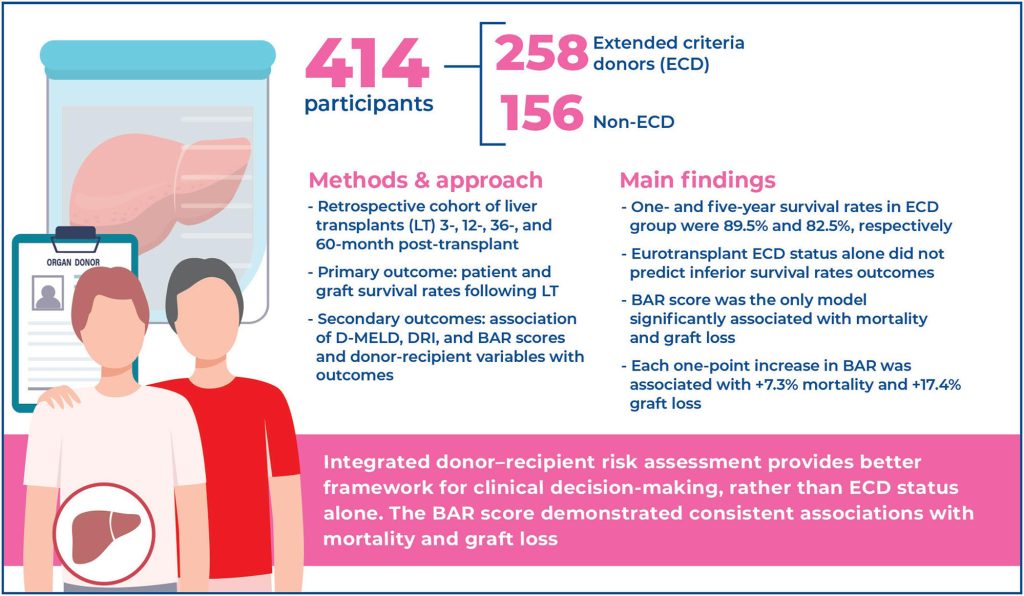
■ The 1- and 5-year survival rates in extended criteria donor group were 89.5% and 82.5%, respectively.
■ Eurotransplant extended criteria donor status alone was not correlated with inferior survival outcomes.
■ The BAR score was the only model associated with mortality and graft loss.
■ Each one-point BAR increased mortality by 7.3% and graft loss by 17.4.
ABSTRACT
Objective:
This study aimed to evaluate the association between the use of extended criteria donors and post-transplant outcomes in a Brazilian liver transplantation center and to compare the prognostic performance of established severity scores.
Methods:
We conducted a retrospective observational study of liver transplantation performed between 2016 and 2020. Patient and graft survivals were assessed at 3, 12, 36, and 60 months. Extended criteria donor status was defined according to the Eurotransplant criteria. The predictive values of the Donor-Model for End-Stage Liver Disease, Donor Risk Index, and Balance of Risk scores were analyzed using categorical and continuous models.
Results:
Among 414 transplants, 62% (n=258) involved extended criteria donor grafts. One- and five-year patient survival rates were 89.5% and 82.5%, respectively, with no significant difference between extended criteria donor and non-extended criteria donor groups (log-rank p=0.074). The extended criteria donor classification was not independently associated with mortality. The Balance of Risk score was the only prognostic model significantly associated with mortality and graft loss. Each one-point increase in the Balance of Risk was associated with a 7.3% increase in mortality risk (hazard ratio [HR]=1.073; 95% confidence interval [95%CI], 1.016-1.133; p=0.012) and a 17.4% increase in graft loss risk (HR=1.174; 95%CI=1.073-1.284; p<0.001).
Conclusion:
In this cohort, extended criteria donor status alone did not predict inferior survival, whereas the Balance of Risk score demonstrated consistent prognostic discrimination. These findings support the use of integrated donor-recipient risk assessment to guide organ acceptance and allocation decisions in liver transplantation.
[…]