einstein (São Paulo). 01/Apr/2026;24:eAO1627.
COVID-19 pandemic-driven evolution of Klebsiella pneumoniae : rising resistance, genetic diversity, and virulence in a Brazilian tertiary hospital

DOI: 10.31744/einstein_journal/2026AO1627
Highlights
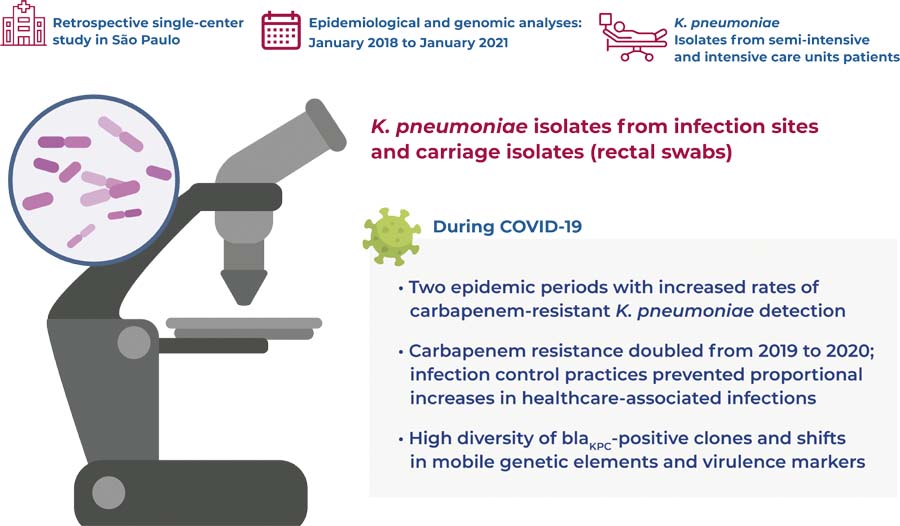
■ Carbapenem resistance rose sharply during the COVID-2019 pandemic, doubling from 2019 to 2020, while infection control practices prevented proportional increases in healthcare-associated infections.
■ Genomic analyses revealed high diversity among blaKPC-positive isolates, with an expansion of sequence types and a predominance of sporadic non-outbreak clones throughout the pandemic period.
■ Shifts in mobile genetic elements and virulence markers occurred during the pandemic, including the emergence of the integrative and conjugative element of Klebsiella pneumoniae ICEKp4, changes in O-antigen types, and reduced prevalence of pKpQIL-like plasmids.
ABSTRACT
Objective:
Coronavirus disease 2019 (COVID-19) caused increased intensive care unit admissions, invasive procedures, and antimicrobial use, potentially worsening bacterial infections and multidrug resistance. Retrospective studies have found that Klebsiella pneumoniae co-infections in COVID-19 patients were significant and possibly linked to mechanical ventilation and central catheter placement. In the present study, we assessed the genetic diversity and antimicrobial resistance of K. pneumoniae isolates collected before and during the pandemic to evaluate the effect of the pandemic on these factors.
Methods:
Antimicrobial resistance profiling, whole-genome sequencing, and phylogenetic analyses were used to examine resistance patterns, genetic diversity, and mobile genetic elements.
Results:
From January 2018 to January 2021, 263 K. pneumoniae isolates were identified from infection sites. Carbapenem-resistant isolates increased from 32.5% in 2019 to 60.3% in 2020, remaining stable until January 2021. Nevertheless, healthcare-associated infections did not increase significantly, highlighting the effectiveness of infection control programs. Whole-genome sequencing showed that 54% of carbapenem-resistant isolates carried plasmids resembling pKPC_FCF3SP (IncN) and pKpQIL-like (IncFII) plasmids; however, the number of pKpQIL-like plasmid carriers declined during the pandemic likely due to patient transfer carrying isolates with distinct mobilome. Simultaneously, the number of plasmid-negative isolates increased by 25%. Carbapenem-resistant isolates showed multidrug resistance, particularly to cephalosporins and fluoroquinolones; however, aminoglycosides remained effective. Genetic analysis identified ten aminoglycoside resistance genes, with aac(6′)-Ib-D181Y associated with improved substrate recognition, being the most prevalent. Virulence factors included four integrative conjugative elements, with the integrative conjugative element K. pneumoniae ICEKp4 found only in pandemic period isolates. The O4 and O2 antigens predominated, whereas O3b appeared exclusively during the pandemic.
Conclusion:
The COVID-19 pandemic has contributed to a rise in carbapenem-resistant K. pneumoniae , underscoring the need for ongoing surveillance. Molecular shifts reflect the adaptation of the pathogen to evolving clinical settings.
[…]
Keywords: Klebsiella pneumoniae; COVID-19; cgMLST; Plasmids; Virulence; Infections; Colonization
15