21/Oct/2020
During which period should we avoid cholecystectomy in patients who underwent endoscopic retrograde cholangiopancreatography?
einstein (São Paulo). 21/Oct/2020;18:eAO5393.
View Article21/Oct/2020
During which period should we avoid cholecystectomy in patients who underwent endoscopic retrograde cholangiopancreatography?
DOI: 10.31744/einstein_journal/2020AO5393
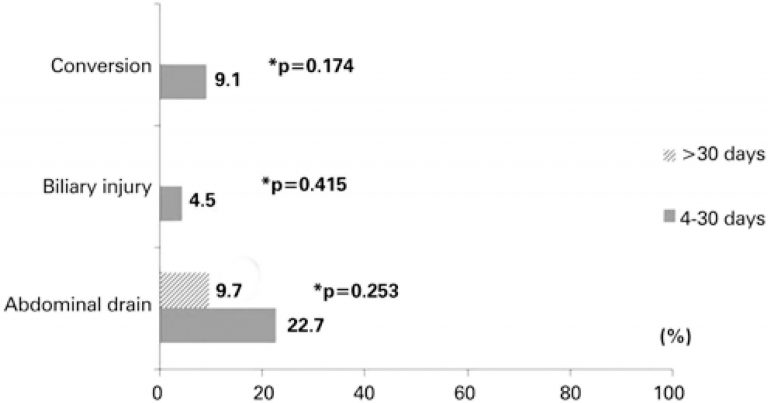
ABSTRACT Objective: To determine the period during which we should avoid cholecystectomy after endoscopic retrograde cholangiopancreatography. Methods: A retrospective analysis of electronic medical charts of 532 patients undergoing endoscopic retrograde cholangiopancreatography, between March 2013 and December 2017. Results: Approximately one-third of patients underwent the procedure between 4 and 30 days after endoscopic retrograde cholangiopancreatography. The conversion rate was 3.8%. The need for abdominal drainage and the finding of biliary tract injury after surgery were observed in 15.1% and 1.9% of […]
Keywords: Cholangiopancreatography, endoscopic retrograde; Cholecystectomy; Cholelithiasis; Laparoscopy
09/Oct/2020
Comparison of senescence progression in mesenchymal cells from human umbilical cord walls measured by immunofluorescence and flow cytometry of p16 and p21
einstein (São Paulo). 09/Oct/2020;18:eAO5236.
View Article09/Oct/2020
Comparison of senescence progression in mesenchymal cells from human umbilical cord walls measured by immunofluorescence and flow cytometry of p16 and p21
DOI: 10.31744/einstein_journal/2020AO5236
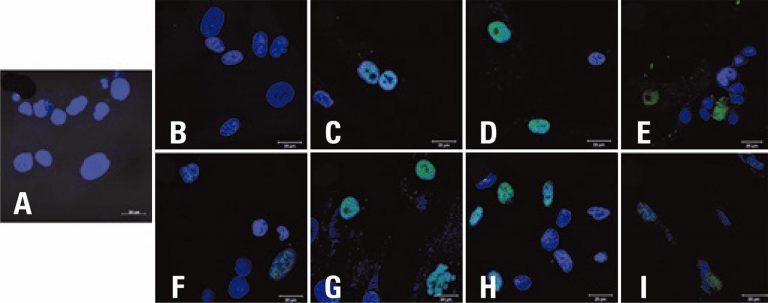
ABSTRACT Objective To follow the expansion of mesenchymal stem cells from umbilical cords by two classic senescence markers, p16 (INK4A) and p21 (CDKN1A), using practical, fast, and less expensive methods than the gold standard Western blotting technique, to evaluate its applicability in the laboratory. Methods Mesenchymal stem cells from umbilical cords were isolated from Wharton’s jelly and, after quality control, morphological and immunophenotypic characterization by flow cytometry, were expanded in culture until coming close to cell cycle arrest (replicative senescence). […]
Keywords: Cellular senescence; Cyclin-dependent kinase inhibitor p21; Flow cytometry; Immunofluorescence; Mesenchymal stem cells
02/Oct/2020
Length of stay in pediatric intensive care unit: prediction model
DOI: 10.31744/einstein_journal/2020AO5476
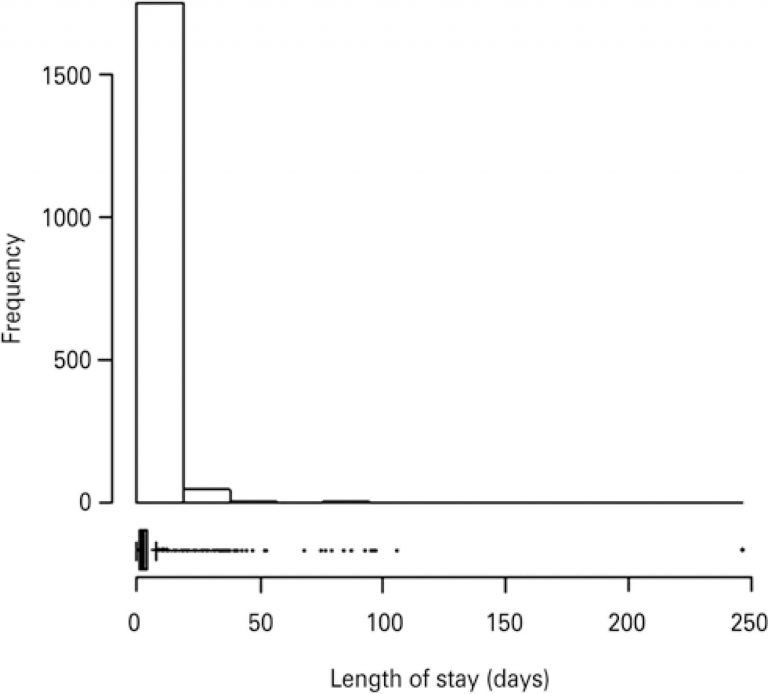
ABSTRACT Objective To propose a predictive model for the length of stay risk among children admitted to a pediatric intensive care unit based on demographic and clinical characteristics upon admission. Methods This was a retrospective cohort study conducted at a private and general hospital located in the municipality of Sao Paulo, Brazil. We used internal validation procedures and obtained an area under ROC curve for the to build of the predictive model. Results The mean hospital stay was 2 days. […]
Keywords: Beds/supply & distribution; Critical care; Forecasting; Heath management; Intensive care units, pediatric; Lengh of stay; Logistic models
02/Oct/2020
In silico investigation of heparanase-correlated genes in breast cancer subtypes
DOI: 10.31744/einstein_journal/2020AO5447
ABSTRACT Objective To investigate the possible genes that may be related to the mechanisms that modulate heparanase-1. Methods The analysis was conducted at Universidade Federal de São Paulo, on the data provided by: The Cancer Genome Atlas, University of California Santa Cruz Genome Browser, Kyoto Encyclopedia of Genes and Genomes Pathway Database, Database for Annotation, Visualization and Integrated Discovery Bioinformatics Database and the softwares cBioPortal and Ingenuity Pathway Analysis. Results Using messenger RNA expression pattern of different molecular subtypes of […]
Keywords: Breast neoplasms; Computational biology; Heparanase-1
02/Oct/2020
Cross-cultural adaptation and semantic validation of an instrument to identify palliative requirements in Portuguese
DOI: 10.31744/einstein_journal/2020AO5539
ABSTRACT Objective To translate and make cross-cultural adaptation of NECPAL CCOMS-ICO© tool to Portuguese, and to analyze its semantic validity. Methods A methodological research about NECPAL CCOMS-ICO© tool cross-cultural adaptation, translated from Spanish into Portuguese and measurement of semantic validity. The cross-cultural adaptation process was conducted according to Beaton recommendations, including translation, translation synthesis, back-translation, and analysis of semantic, idiomatic, conceptual, and cultural equivalence of translated and back-translated tool versions, resulting in a pre-final version, which was submitted to a […]
Keywords: Chronic disease; Palliative care; Patient care management; Patient identification systems; Surveys and questionnaires; Validation study
16/Sep/2020
Analysis of brain death declaration process and its impact on organ donation in a reference trauma center
einstein (São Paulo). 16/Sep/2020;18:eAO5448.
View Article16/Sep/2020
Analysis of brain death declaration process and its impact on organ donation in a reference trauma center
DOI: 10.31744/einstein_journal/2020AO5448
ABSTRACT Objective To characterize the processes of brain death diagnosis and organ donation in a reference trauma center. Methods Observational and cross-sectional study with patients notified with brain death at a reference trauma center. Data were obtained through the collection of medical records and brain death declaration forms. Results One hundred fity-nine patients were notified with brain death, mostly male (82.6%), young adults (97.61%) and victims of brain traumatic injury (93.7%). Median of the total time interval for the diagnosis […]
Keywords: Brain death; Brain injuries, traumatic; Tissue and organ procurement; Wound and injuries
16/Sep/2020
Improvement in parameters of quality of life and uterine volume reduction after uterine fibroid embolization
DOI: 10.31744/einstein_journal/2020AO5458
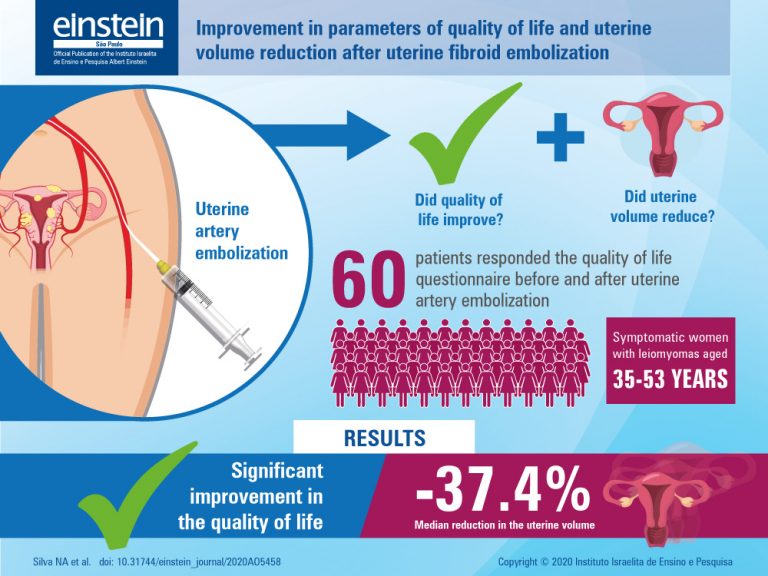
ABSTRACT Objective To evaluate improvement in quality of life, reduction of uterine volume, and the correlation between these two variables after uterine fibroid embolization. Methods Data on quality of life before and after uterine fibroid embolization were collected from 60 patients using the Uterine Fibroid Symptom – Quality of Life questionnaire. In 40 of these patients, uterine volume information on magnetic resonance imaging examinations performed before and after uterine fibroid embolization was collected, and compared using the nonparametric Wilcoxon test […]
Keywords: Embolization, therapeutic; Leiomyoma; Quality of life; Treatment outcome
09/Sep/2020
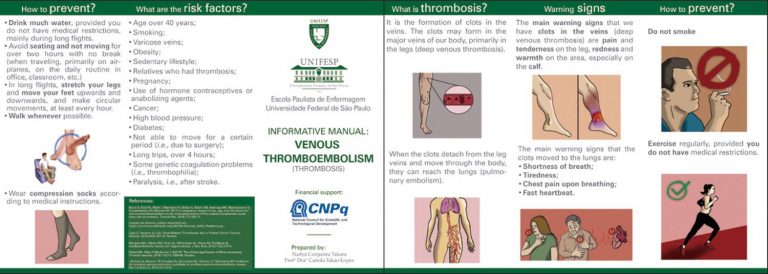
Development and validation of an informative manual on venous thromboembolism for the lay population
DOI: 10.31744/einstein_journal/2020AO5425
ABSTRACT Objective To develop an informative manual on venous thromboembolism prevention for the lay population and to estimate evidences of content and face validity. Methods A methodological study conducted in three stages. The first stage was the preparation of the manual, followed by content validation with cardiovascular specialists who judged clarity, theoretical relevance and practical pertinence on a 4-point Likert scale. Items with a content validity index ≤0.75 were revised and re-evaluated. The last stage was the face validation by […]
Keywords: Education, nursing; Pulmonary embolism; Risk Factors; Validation study; Venous thromboembolism
09/Sep/2020
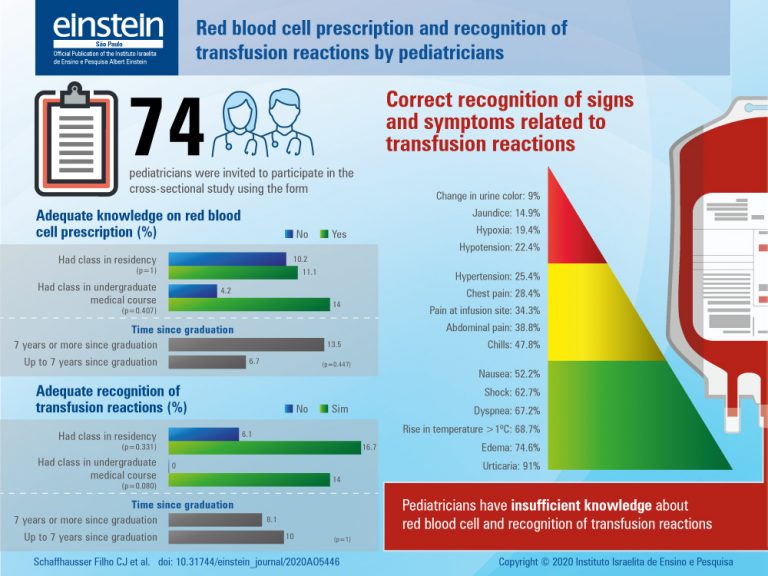
Red blood cell prescription and recognition of transfusion reactions by pediatricians
DOI: 10.31744/einstein_journal/2020AO5446
ABSTRACT Objective To assess the level of knowledge of emergency pediatricians on red blood cell transfusions and their reactions. Methods Written survey with emergency pediatricians from a pediatric hospital. Results Less than 20% of pediatricians showed appropriate knowledge on prescribing red blood cells and recognition of transfusion reactions. There was no significant statistical regarding time since graduation and blood transfusion classes in undergraduate studies or during medical residency. Conclusion Pediatricians have insufficient knowledge about red blood cell transfusions and recognition […]
Keywords: Child; Education, medical; Erythrocyte transfusion; Transfusion medicine; Transfusion reaction
09/Sep/2020
Prevalence of palliative sedation in the State of São Paulo: an emerging medical demand
DOI: 10.31744/einstein_journal/2020AO5395
ABSTRACT Objective To investigate the prevalence of palliative sedation use and related factors. Methods An observational study based on data collected via electronic questionnaire comprising 23 close-ended questions and sent to physicians living and working in the state of São Paulo. Demographic data, prevalence and frequency of palliative sedation use, participant’s familiarity with the practice and related motivating factors were analyzed. In order to minimize memory bias, questions addressing use frequency and motivating factors were limited to the last year […]
Keywords: Advance care planning; Bioethics; Deep sedation; Pain management; Palliative care; Terminal care