einstein (São Paulo). 08/Apr/2026;24:eAO1827.
Accuracy of oxidative stress markers for predicting delayed graft function lasting longer than a week in deceased-donor kidney transplantation

DOI: 10.31744/einstein_journal/2026AO1827
Highlights
■ Oxidative stress markers are associated with the intensity and consequences of ischemia-reperfusion injury during deceased-donor kidney transplantation.
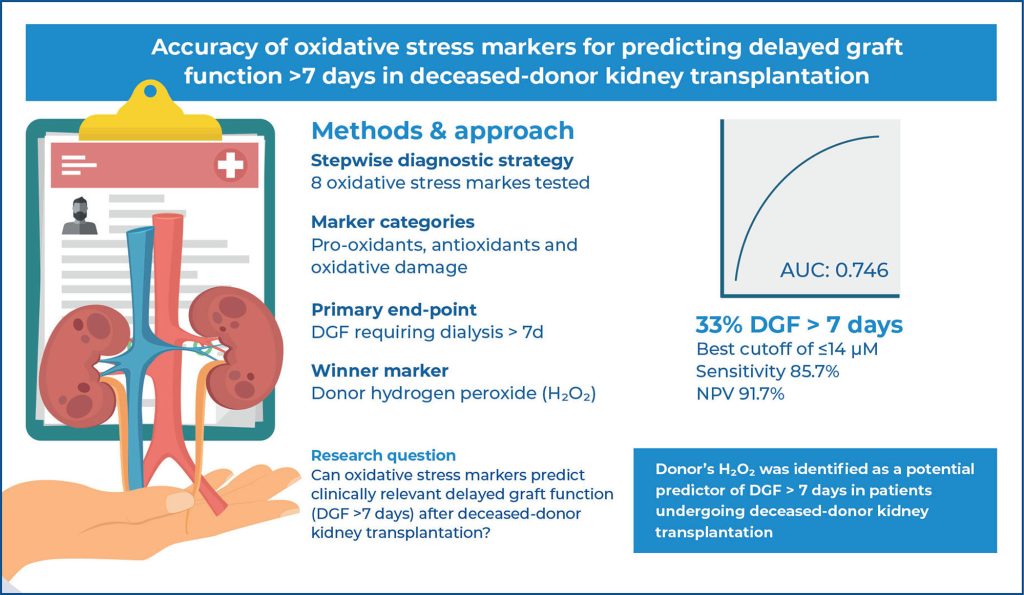
■ The donor’s serum hydrogen peroxide level achieved 85.7% sensitivity and a 91.7% negative predictive value for detecting delayed graft function lasting more than one week.
■ Donor H2O2 ≤14μM is suggested to dichotomize risk for delayed graft function lasting longer than a week.
■ This study provides pivotal information on the use of oxidative stress markers to identify patients at high risk of requiring dialysis beyond the first post-transplant week.
ABSTRACT
Objective:
To assess the accuracy of oxidative stress markers in predicting delayed graft function (DGF) lasting more than one week after deceased-donor kidney transplantation (KTx).
Methods:
A translational pilot study was carried out and a five-step hierarchical diagnostic accuracy strategy was applied to evaluate the predictive value of oxidative stress markers for DGF >7 days in adult patients with end-stage kidney disease undergoing deceased-donor KTx. Statistics comprise multiple conventional methods, C-statistics, and diagnostic test performance measures.
Results:
Cohort analysis of 27 consecutive patients revealed that 33.3% (9/27) developed DGF >7 days. Assessment of the oxidative stress markers selected in the first statistical step comparing donors and controls revealed a significant correlation of the DGF duration with the recipient’s protein oxidation (ρ=0.466; p=0.022) as well as donor’s hydrogen peroxide (ρ=-0.489; p<0.014). The areas under the curve were 0.683 (95% confidence interval [95%CI], 0.458-0.859; p=0.224) and 0.746 (95%CI=0.534-0.897; p=0.019), respectively. A cutoff of ≤14 μM H2O2 had the highest level of discriminating power for predicting DGF >7 days. The sensitivity, specificity, positive predictive value, negative predictive value, and overall diagnostic accuracy to identify patients at risk for experiencing DGF >7 days was 85.7%, 61.1%, 46.1%, 91.7%, and 68%, respectively.
Conclusion:
Donor hydrogen peroxide was identified as a potential predictor of DGF >7 days in patients who underwent deceased-donor KTx. A cut-off value of ≤14 μmol/L is suggested to stratify patients at high risk of requiring dialysis beyond the first post-transplant week.
[…]
Keywords: Kidney transplantation; Oxidative stress; Graft survival
2