5 results
02/Apr/2026
02/Apr/2026
DOI: 10.31744/einstein_journal/2026AO1666
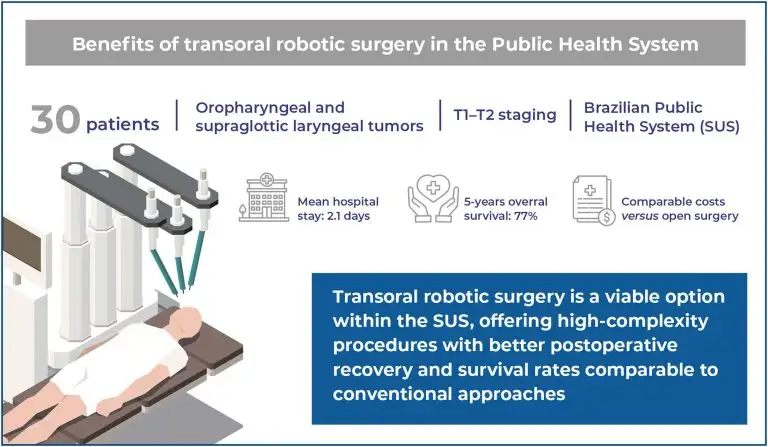
Highlights ■ Transoral robotic surgery applied in patients with T1–T2 oropharyngeal and laryngeal tumors. ■ Mean hospital stay: 2.1 days. ■ Minimal postoperative complications. ■ 5-year survival: 77%, with comparable cost-effectiveness. ABSTRACT Objective: To assess the feasibility and benefits of transoral robotic surgery in the public healthcare system and to conduct a cost analysis of its implementation. Methods: This prospective, nonrandomized, observational cohort study was conducted over 24 months and included patients with T1-T2 oropharyngeal and supraglottic laryngeal tumors. Results: […]
Keywords: Costs and cost analysis; Head and neck neoplasms; Minimally invasive surgical procedures; Robotic surgical procedures; Robotics
01/Oct/2016
01/Oct/2016
DOI: 10.1590/S1679-45082016MD3658
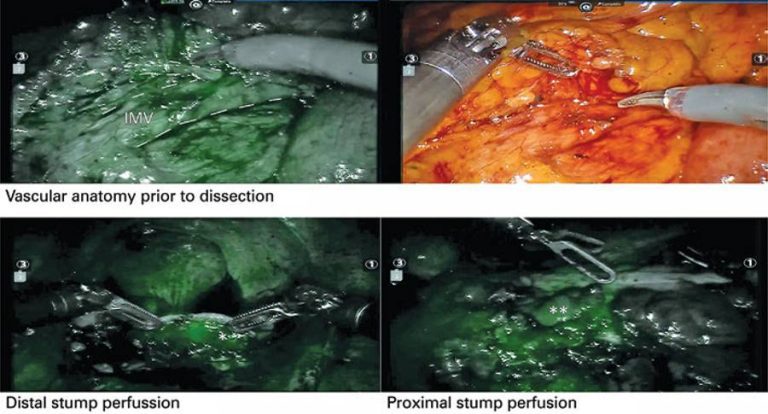
ABSTRACT The intraoperative identification of certain anatomical structures because they are small or visually occult may be challenging. The development of minimally invasive surgery brought additional difficulties to identify these structures due to the lack of complete tactile sensitivity. A number of different forms of intraoperative mapping have been tried. Recently, the near-infrared fluorescence imaging technology with indocyanine green has been added to robotic platforms. In addition, this technology has been tested in several types of operations, and has advantages […]
Keywords: Cholecystectomy; Colectomy; Fluorescence; Indocyanine green; Intraoperative period; Robotics
21/Aug/2015
21/Aug/2015
DOI: 10.1590/S1679-45082015MD3374
Vein access can be challenging for a variety of patients. The development of robots-assisted central or peripheral veins puncture would facilitate life of health professionals and patients. New robots are under development for this purpose and probably they will become available for practical use in the near future. These techniques may decrease significantly the cost of medicine, which currently uses less informatics resources than other industries.
Keywords: Artificial intelligence; Catheterization, central venous/instrumentation; Catheterization, central venous/methods; Robotics; Vascular access devices/trends
15/Oct/2013
DOI: 10.1590/S1679-45082013000300007
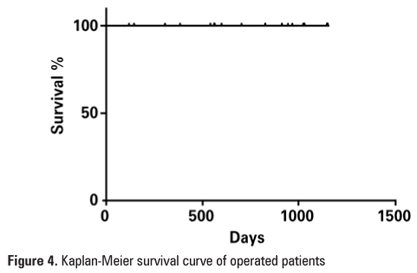
OBJECTIVE: To evaluate the short and medium-term outcomes of patients undergoing robotic-assisted minimally invasive cardiac surgery. METHODS: From March 2010 to March 2013, 21 patients underwent robotic-assisted cardiac surgery. The procedures performed were: mitral valve repair, mitral valve replacement, surgical correction of atrial fibrillation, surgical correction of atrial septal defect, intracardiac tumor resection, totally endoscopic coronary artery bypass surgery and pericardiectomy. RESULTS: The mean age was 48.39±18.05 years. The mean cardiopulmonary bypass time was 151.7±99.97 minutes, and the mean aortic […]
Keywords: Atrial fibrillation; Cardiac surgery; Heart defects, congenital; Heart septal defects, atrial; Mitral valve; Myocardial revascularization; Pericardium; Robotics; Surgical procedures, minimally invasive
01/Jul/2010
DOI: 10.1590/S1679-45082010MD1558
ABSTRACT Considering the Health Care System in Brazil, a developing country, and public healthcare policies, robotic surgery is a reality to very few citizens. Therefore, robotic assisted radical prostatectomy is far removed from the daily practice of the vast majority of Brazilian urologists. Scientific evidence of the superiority of robotic assisted radical prostatectomy does not presently justify public investments for widespread development of robotic centers. Maybe over time and with reductions in costs, robotic technology will become a more established […]
Keywords: Health care costs; Prostatectomy/methods; Prostatic neoplasms/surgery; Robotics