3 results
08/Jun/2026
08/Jun/2026
DOI: 10.31744/einstein_journal/2026AO2130
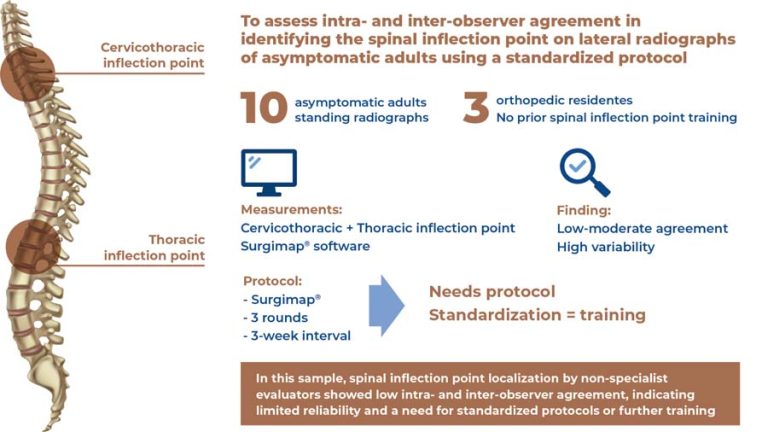
Highlights ■ Inflection point agreement was low to moderate amongnon-specialist raters. ■ Thoracolumbar junction showed the lowest inter-observeragreement. ■ Results support the need for protocol standardization and structured training. ABSTRACT Objective: To assess the intra- and inter-observer reliability of spinal inflection point localization on lateral radiographs of asymptomatic adults using a standardized measurement protocol, given its important role in sagittal alignment analysis and its potential influence on biomechanical interpretation and surgical planning. Methods: This cross-sectional study included 10 adults (five […]
Keywords: Diagnostic imaging; Observer variation; Radiography; Reproducibility of Results; Spinal; Spinal diseases
13/Nov/2025
13/Nov/2025
DOI: 10.31744/einstein_journal/2025AO1947
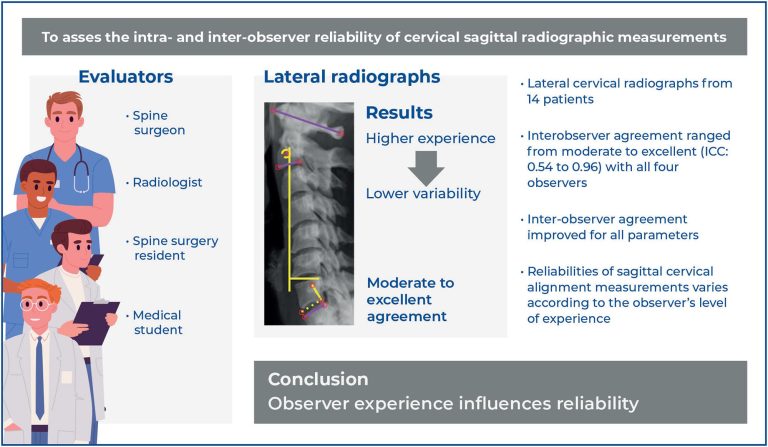
Highlights ■ Observer experience improves radiographic measurement reliability. ■ Spine surgeons and radiologists exhibited the highest intra-class correlation coefficients. ■ The cervical sagittal vertical axis showed the greatest inter-observer variability. ■ Standardized training may enhance measurement consistency. ABSTRACT Objective: To assess the intra- and inter-observer reliabilities of cervical sagittal radiographic measurements performed by evaluators with varying levels of clinical experience. Methods: This study analyzed lateral cervical radiographs from 14 patients who had undergone single-level anterior cervical discectomy and fusion. Four […]
Keywords: Cervical vertebrae; Diskectomy; Observer variation; Radiographic image interpretation, computer-assisted; Radiologists; Reproducibility of Results; Spinal fusion; Spine; Students, medical; Surgeons
22/Jan/2013
DOI: 10.1590/S1679-45082012000400014
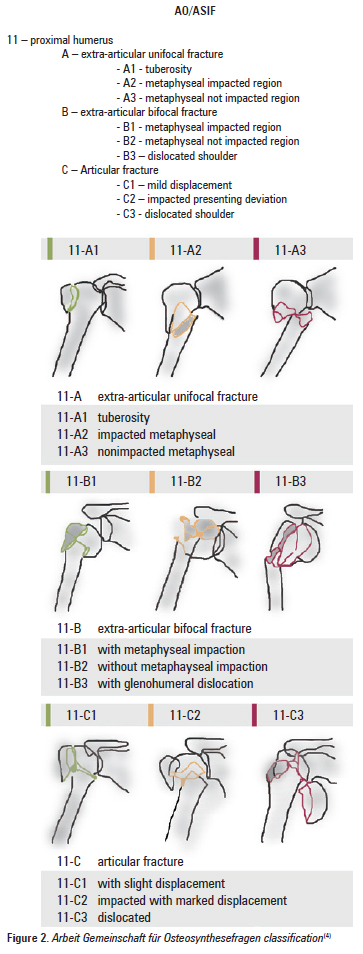
OBJECTIVE: To propose a new system for classifying proximal humeral neck fractures, and to evaluate intra- and interobserver agreement using the Neer system that is the most commonly used in the area and the Arbeit Gemeinschaft für Osteosynthesefragen system created by an European group, and a new classification system proposed by the authors of this study. METHODS: A total of 56 patients with proximal humeral fractures were selected, and submitted to digitized simple radiography in antero-posterior shoulder and scapular profile. […]
Keywords: Observer variation; Shoulder fractures