einstein (São Paulo). 08/Apr/2026;24:eAO1266.
The use of an objective method (continuous exosomatic electrodermal activity without external stimuli) to evaluate patients with hyperhidrosis undergoing video-assisted sympathectomy

DOI: 10.31744/einstein_journal/2026AO1266
Highlights
■ EDAcw objectively quantifies sweating in patients with hyperhidrosis.
■ Sympathectomy significantly reduced EDAcw and improved the quality of life.
■ The hands showed a 97% reduction in electrodermal activity postoperatively.
■ EDAcw is a reliable non-invasive tool for clinical evaluation and follow-up.
ABSTRACT
Objective:
To analyze continuous exosomatic electrodermal activity (EDA) without external stimuli (EDAcw) in patients with primary hyperhidrosis before and after sympathectomy.
Methods:
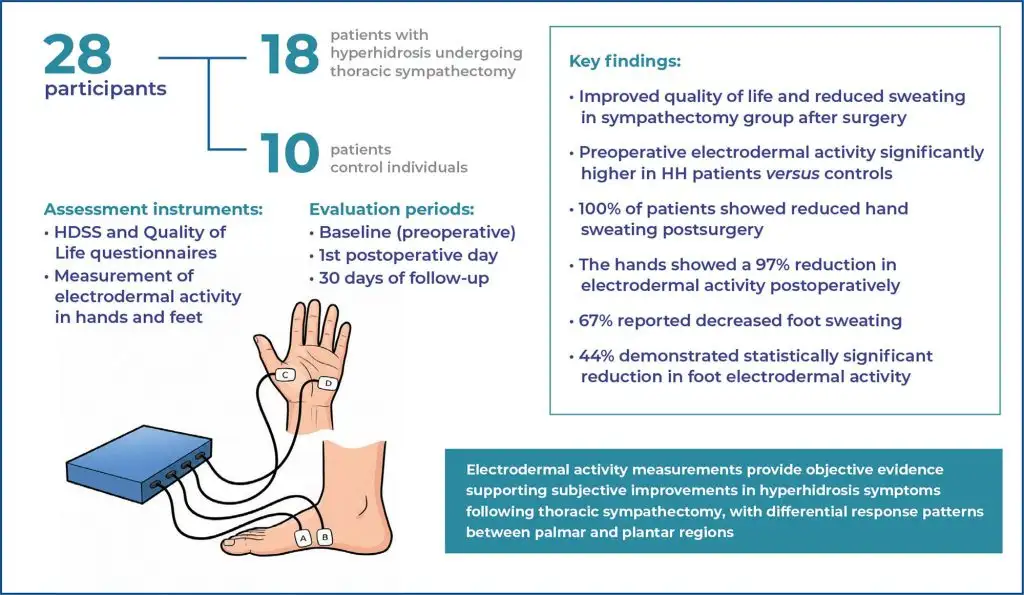
This prospective study included 28 participants, categorized into two groups. The first group comprised 18 patients with palmoplantar hyperhidrosis who underwent bilateral thoracic sympathectomy. The second group (control) consisted of 10 patients. Two questionnaires were administered: the Control Group completed them once, whereas the Sympathectomy Group completed them preoperatively, and on the first and thirtieth postoperative days. Sweating was evaluated by measuring EDAcw using an MP36R biosensor. Measurements were obtained from the hands and feet for 5 min without external stimuli in an air-conditioned environment and were performed preoperatively, and on the first and thirtieth postoperative days. Anthropometric, clinical, and surgical data were collected, and no significant sociodemographic differences were observed between the groups.
Results:
In the Sympathectomy Group, quality of life improved, and sweating reduced. During preoperative assessment, EDA was higher in the hands and feet of patients with hyperhidrosis than in the Control Group. Postoperatively, EDA in the hands decreased, with 100% of the patients showing a decrease in sweating. For the feet, 67% of the patients reported reduced sweating, and 44% showed a statistically significant decline in EDA.
Conclusion:
Continuous exosomatic EDA measurement without external stimuli is a suitable method for assessing patients with palmoplantar hyperhidrosis and shows appropriate clinical correlation.
[…]
2