einstein (São Paulo). 02/Apr/2026;24:eAO1922.
Prospective study of the behavior of totally implantable catheters in female oncology patients with mammary hypertrophy

DOI: 10.31744/einstein_journal/2026AO1922
Highlights
■ Mammary hypertrophy was not associated with postoperative totally implantable venous access device catheter tip displacement.
■ Upright and supine chest radiography with a radiopaque ruler allowed precise quantification of catheter tip displacement.
■ Non-deforming chest wall surgery and a history of peripherally inserted central catheters history were significantly associated with catheter tip migration.
ABSTRACT
Objective:
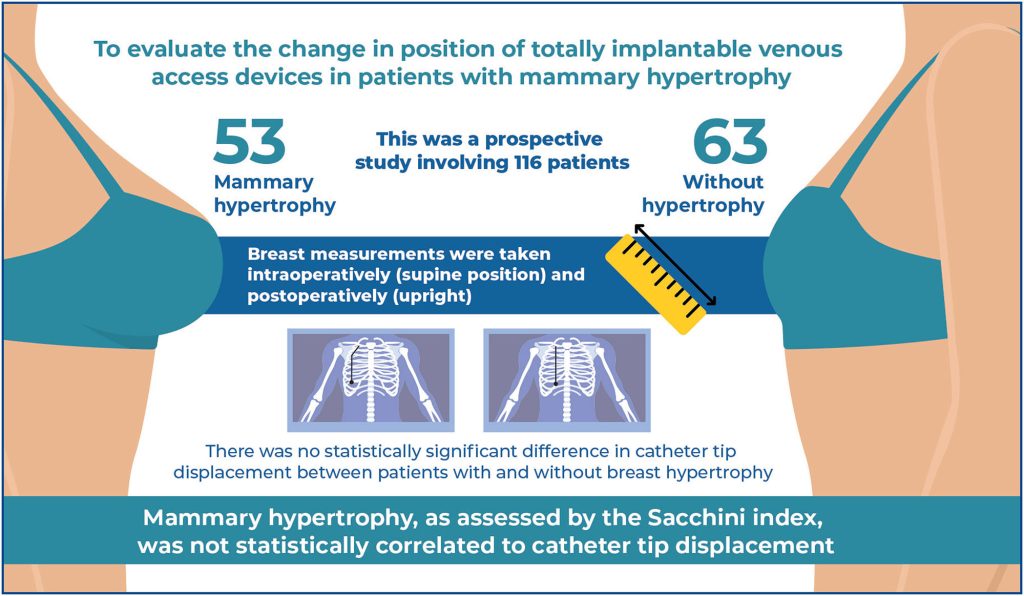
This study aimed to evaluate the change in the position of totally implantable venous access devices in patients with mammary hypertrophy compared to patients without this condition, in both supine and upright positions.
Methods:
This was a prospective study involving 116 female patients who underwent implantation of totally implantable venous access devices in the internal jugular vein with reservoir placement in the infraclavicular region of the chest wall. Patients with mammary hypertrophy were compared to a Control Group of patients with normotrophic breasts. Mammary hypertrophy was defined on the basis of the Sacchini index. The catheter tip was placed at the cavoatrial junction. The distances between the tip of the catheter and carina were compared intraoperatively and postoperatively. Measurements were performed using a radiopaque ruler intraoperatively under fluoroscopy and postoperatively with posteroanterior chest radiography in the upright position.
Results:
Of the 116 female patients, 53 (46.7%) had mammary hypertrophy, and 63 constituted the Control Group (53.3%). Displacement of the catheter tip in the cranial direction correlated with the previous presence of a peripherally inserted central catheter on the same side as the totally implantable venous access device (p=0.042). In contrast, caudal displacement correlated with non-deforming surgery on the chest wall (p=0.002). Patients with mammary hypertrophy did not show a higher incidence of catheter tip displacement than those with normotrophic breasts (p=0.182).
Conclusion:
Mammary hypertrophy, assessed using the Sacchini index, did not significantly correlate with catheter tip displacement.
[…]
12