einstein (São Paulo). 01/Apr/2026;24:eAO1574.
Evaluation of the effects of Plasma-Lyte 148 or 0.9% saline on acid-base balance in patients undergoing neurosurgery: a randomized clinical trial

DOI: 10.31744/einstein_journal/2026AO1574
Highlights
■ This randomized controlled trial in elective neurosurgery adds important evidence to the growing body of literature comparing Plasma-Lyte 148 with 0.9% saline in specialized surgical populations.
■ Plasma-Lyte 148 demonstrated superior acid-base homeostasis with significantly higher bicarbonate levels and base excess at surgical completion, whereas 0.9% saline induced hyperchloremia in the saline group.
■ The biochemical advantages of Plasma-Lyte 148 align with current evidence supporting balanced crystalloids as the preferred choice in perioperative fluid management.
■ These findings support the emerging consensus favoring balanced crystalloids over normal saline, particularly in populations where acid-base homeostasis is critical.
■ Our findings contribute to the paradigm shift toward Plasma-Lyte 148 as the preferred crystalloid solution in neurosurgical practice, consistent with recent international guidelines.
ABSTRACT
Objective:
The choice of crystalloid solution considerably affects perioperative outcomes in neurosurgery. This study aimed to evaluate the effects of Plasma-Lyte 148 and 0.9% saline on acid-base and hydroelectrolyte balance in adults undergoing elective neurosurgical procedures.
Methods:
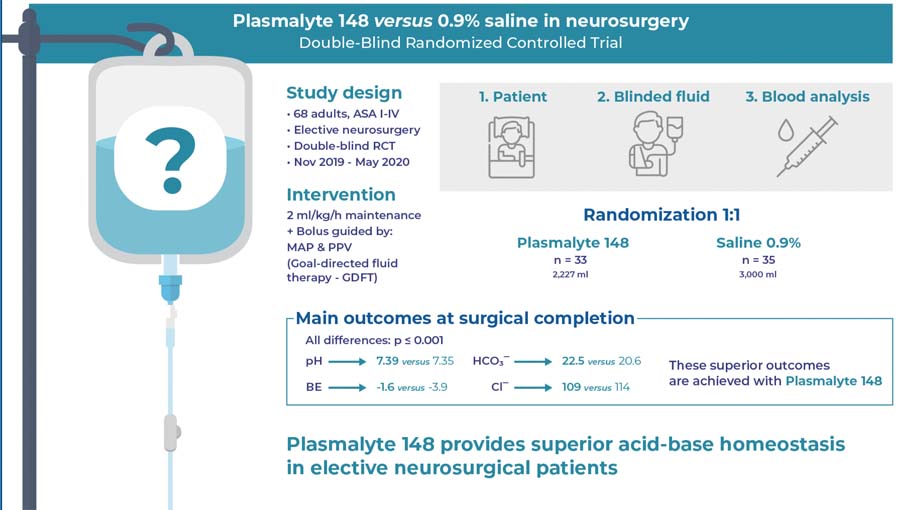
A double-blind randomized controlled trial was conducted at Botucatu Medical School from November 2019 to May 2020. Patients received either Plasma-Lyte 148 or 0.9% saline at a maintenance rate of 2mL/kg/h, with additional bolus guided by mean arterial pressure and pulse pressure variation. The primary endpoint was arterial pH at the end of surgery.
Results:
Sixty-eight patients (33 in the Plasma-Lyte 148 group and 35 in the saline group) completed the study. The total median volumes administered (1st-3rd quartiles) were 2,227 (1,416-3,000) and 3,000 (2,000-4,000) mL in the Plasma-Lyte 148 and saline groups, respectively (p=0.107). At procedure completion, Plasma-Lyte 148 demonstrated superior acid-base homeostasis with significantly higher pH (7.39±0.04 versus 7.35±0.05, p<0.001), bicarbonate (22.5±1.8 versus 20.6±2.2mmol/L, p<0.001), and base excess (−1.6±2.3 versus −3.9±2.6, p<0.001), while preventing hyperchloremia (109.1±6.6 versus 113.9±4.5 mmol/L, p=0.001).
Conclusion:
Plasma-Lyte 148 provides superior acid-base homeostasis compared to 0.9% saline in patients undergoing neurosurgery, with significantly better pH, bicarbonate, and base excess profiles while avoiding hyperchloremia. These findings support the preferential use of balanced crystalloids in neurosurgical practice, aligning with current evidence favoring Plasma-Lyte 148 for optimal perioperative fluid management. ReBEC platform registration number: RBR-2592-hd.
[…]
14