einstein (São Paulo). 02/Feb/2026;24:eAO1470.
A tertiary care study on the effectiveness of moderate weight loss on heart rate variability frequency-domain components in obese patients at high cardiovascular risk

DOI: 10.31744/einstein_journal/2026AO1470
Highlights
■ The institutional nutritional program in tertiary care was effective in promoting moderate weight loss.
■ Obese patients with high cardiovascular risk undergoing multi-drug therapy showed significant improvement in anthropometric, biochemical, and heart rate variability components.
■ Heart rate variability analysis revealed enhanced autonomic balance, increased parasympathetic activity, and reduced sympathetic activity after weight loss.
■ Moderate weight loss presents a promising adjunctive strategy for managing cardiovascular risk in obese patients undergoing multi-drug therapy.
Abstract
Objective:
Cardiovascular diseases remain the leading cause of mortality, and obesity is a significant risk factor. This study aimed to investigate the impact of a structured nutritional intervention on weight loss, heart rate variability, and biochemical profiles in obese patients with high cardiovascular risk.
Methods:
This was a non-randomized, uncontrolled study on the effectiveness of an institutional nutritional program. Heart rate variability measurements were obtained at baseline and after the nutritional program using a six-channel digital electrocardiograph.
Results:
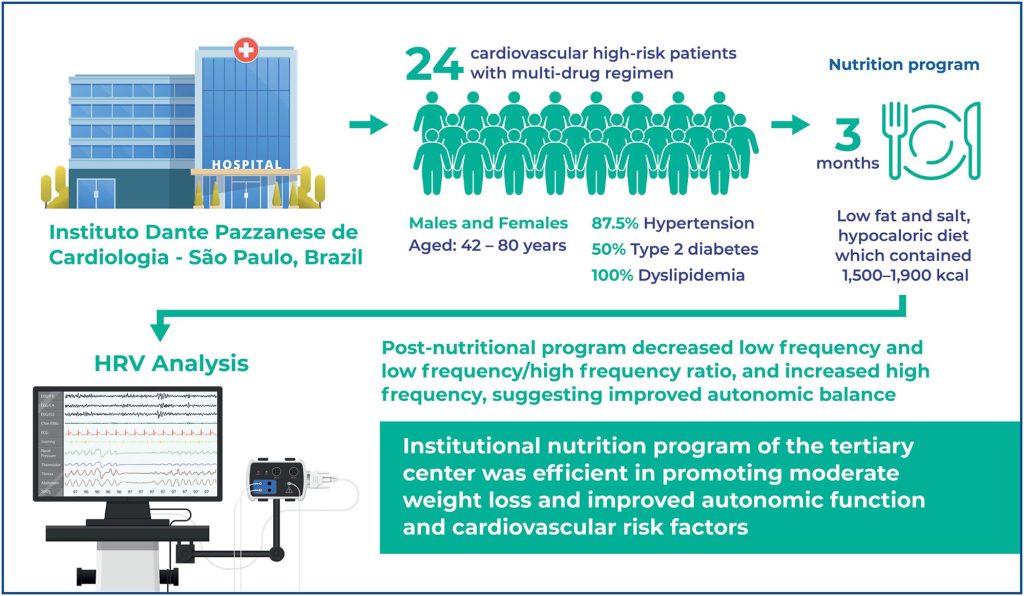
This study included 24 patients with obesity (body mass index >30kg/m²), aged 42-80 years, who underwent a 3-month nutritional program. Significant reductions in body weight (p=0.043), body mass index (p=0.042), and waist circumference (p=0.031) were observed. Biochemical profiles improved, with decreased glycated hemoglobin (p=0.015), total cholesterol (p=0.001), LDLc (p=0.047), and triglycerides (p=0.021), while HDLc remained unchanged. Heart rate variability analysis revealed significant post-nutritional program decreases in low-frequency (p<0.001) and low-frequency/high-frequency ratios (p<0.001), and an increase in high-frequency (p<0.001), suggesting improved autonomic balance. No significant changes were observed in the heart rate, SDNN, pNN50, rMSSD, or triangular index.
Conclusion:
These findings suggest that moderate weight loss can positively influence autonomic function and several cardiovascular risk factors in obese patients with high cardiovascular risk. The nutritional program could be an important adjunctive strategy in the management of patients treated at tertiary care hospitals, offering a promising avenue for cardiovascular risk factor management and building a supportive environment for healthy eating habits.
[…]
5