einstein (São Paulo). 11/mar/2026;24(spe2):eAO1748.
Outcomes of multiple myeloma in patients with access to novel drugs

DOI: 10.31744/einstein_journal/2026AO1748
Highlights
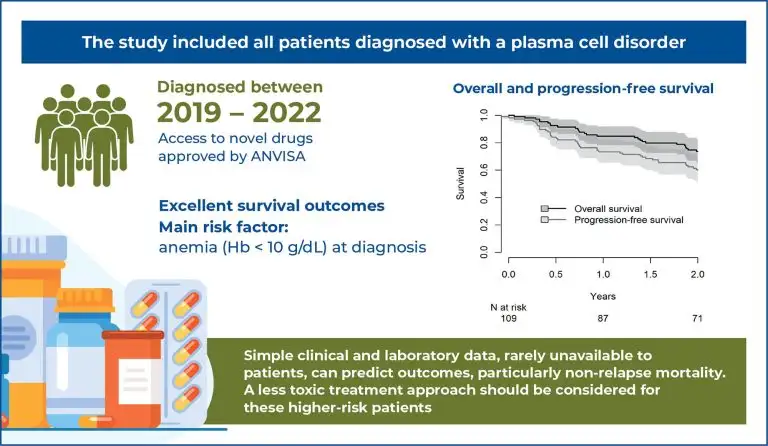
■ Accessibility to novel drugs for multiple myeloma render excellent outcomes.
■ Hemoglobin at diagnosis is a significant risk factor.
■ Age also impacts outcomes.
■ Hemoglobin and age-based model fared better than the International Staging System.
ABSTRACT
Objective:
To report the outcomes of patients with multiple myeloma who had access to novel drugs in Brazil, and to establish a local benchmark.
Methods:
This prospective observational study was conducted at Hospital Israelita Albert Einstein in São Paulo, Brazil. We included all patients diagnosed with plasma cell disorders treated between 2019 and 2022.
Results:
We included 109 patients with a median follow-up of 3.7 years. The three-year overall and progression-free survival rates were 69% and 51%, respectively. Multivariate analysis identified age (HR = 1.60 for each additional 10 years, p=0.0025) and hemoglobin levels (HR = 1.25 for each point decrease, p=0.0038) as risk factors for mortality were identified in a model that fared better than the International Staging System. Our results indicate that basic clinical and laboratory data (age and hemoglobin level) also predict overall survival in modern patients with multiple myeloma with access to novel therapies, similar to the International Staging System.
Conclusion:
Simple clinical and laboratory data, which are rarely available to patients, can predict outcomes, particularly non-relapse mortality. Therefore, a less toxic treatment approach should be considered for high-risk patients.
[…]
Palavras-chave: Multiple myeloma; Prognosis; Treatment outcome; New drugs
15