einstein (São Paulo). 22/maio/2026;24:eAO1541.
Motor reaction time in older women with different degrees of sarcopenia: What do electroencephalograms show?

DOI: 10.31744/einstein_journal/2026AO1541
Highlights
■ Pre-sarcopenic women showed increased cortical excitation during motor tasks.
■ Sarcopenia was associated with slower motor reaction time.
■ EEG revealed central nervous system changes across sarcopenia stages.
■ Pre-sarcopenia may represent a window for early neuromotor intervention.
ABSTRACT
Objective:
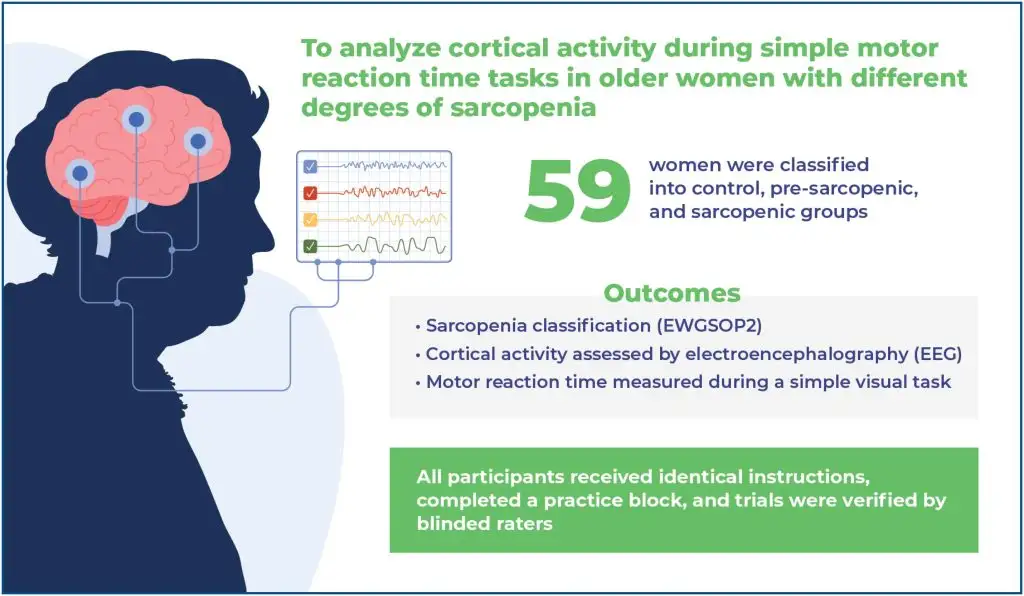
This study aimed to analyze cortical activity during simple motor reaction time tasks in older women with different degrees of sarcopenia.
Methods:
This cross-sectional, observational, analytical study included 59 women classified into control, pre-sarcopenia, and sarcopenia groups according to European Working Group on Sarcopenia in Older People criteria. Motor reaction time was assessed through standardized visual stimuli with simultaneous electroencephalography. All participants received identical instructions and completed a practice block. The trials were verified by blinded raters. Electroencephalogram alpha (8-12 Hz) and beta (12-28 Hz) power ratios were analyzed as markers of cortical excitation using a false discovery rate correction (q=0.05).
Results:
Pre-sarcopenic participants exhibited significantly higher cortical excitation than did the control and sarcopenic groups (p<0.001), suggesting that compensatory hyperactivation precedes cortical decline.
Conclusion:
Sarcopenia involves central neurophysiological changes in addition to muscle atrophy. The pre-sarcopenic stage represents an optimal window for neuromotor intervention given its increased cortical responsiveness.
[…]
Palavras-chave: Sarcopenia; Motor skills; Reaction time; Electroencephalography; Brain mapping; Geriatric; Age