einstein (São Paulo). 21/ago/2026;24(spe3):eAO2476.
Oral cavity as a reservoir of respiratory pathogens: microbial dynamics in patients receiving mechanical ventilation

DOI: 10.31744/einstein_journal/2026AO2476
Highlights
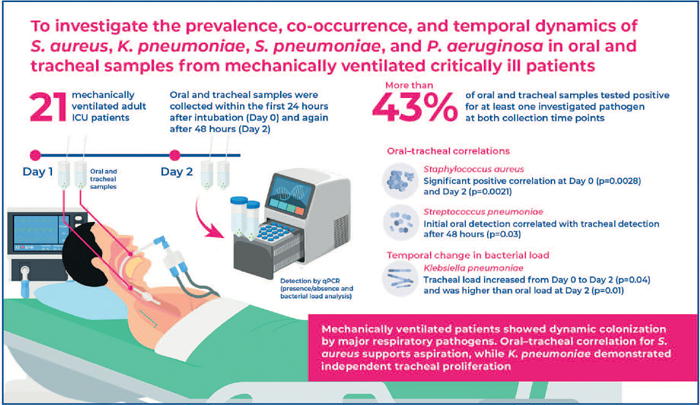
■ Oral and tracheal pathogens persisted throughout mechanical ventilation.
■ S. aureus showed consistent oral-tracheal correlations at both time points.
■ Tracheal K. pneumoniae load increased after 48 hours and exceeded oral load.
■ The oral microbiota may contribute to lower respiratory tract colonization and systemic infection.
ABSTRACT
Objective:
To investigate the prevalence, co-occurrence, and temporal dynamics of Staphylococcus aureus, Klebsiella pneumoniae, Streptococcus pneumoniae, and Pseudomonas aeruginosa in oral and tracheal samples from critically ill patients receiving mechanical ventilation.
Methods:
This observational analytical study included 21 adult patients receiving mechanical ventilation who were admitted to an intensive care unit. Oral and tracheal samples were collected within the first 24 h after intubation (Day 0) and again after 48 h (Day 2). Bacterial genomic deoxyribonucleic acid was extracted and analyzed using quantitative realtime polymerase chain reaction. Microbial detection was evaluated qualitatively based on the presence or absence of each microorganism and quantitatively using relative bacterial load analysis. Statistical analyses assessed correlations between oral and tracheal colonization patterns and temporal changes in bacterial load.
Results:
More than 43% of oral and tracheal samples tested positive for at least one investigated pathogen at both collection time points, indicating persistent microbial colonization during mechanical ventilation. Significant positive correlations for Staphylococcus aureus detection were observed between oral and tracheal samples on Day 0 (p=0.0028) and Day 2 (p=0.0021), suggesting a possible association between oral colonization and lower airway microbial presence. Streptococcus pneumoniae detected in initial oral samples showed a significant correlation with tracheal detection after 48 h (p=0.03). Quantitative analyses demonstrated no significant changes in bacterial load over time for most microorganisms. However, Klebsiella pneumoniae showed a significant increase in tracheal bacterial load between Day 0 and Day 2 (p=0.04), with higher tracheal loads than oral samples on Day 2 (p=0.01).
Conclusion:
The oral cavity may serve as an important reservoir of respiratory pathogens in patients receiving mechanical ventilation. The observed correlations between oral and tracheal colonization and pathogen-specific colonization patterns reinforce the relevance of oral health management in critical care settings. In particular, the increase in tracheal Klebsiella pneumoniae load suggests that lower airway proliferation may occur during mechanical ventilation independently of simultaneous increases in oral bacterial load.
[…]
Palavras-chave: Saliva; Tracheal; Body fluids; Respiration, artificial; Respiratory pathogens; Intensive care unit