einstein (São Paulo). 30/jan/2026;24(Suppl 1):eED0001.
Educating and learning in the Artificial Intelligence era: formative challenges and new roles for the educator

DOI: 10.31744/einstein_journal/2026Suppl_1ED0001
What is lost when generating answers becomes more important than learning?
Artificial intelligence (AI) has ceased to be a prospect and has become a routine tool for study, academic production, and decision-making. Over the past three years, language models based on generative AI have migrated from an interesting technological curiosity to widely available tools, with unprecedented speed and impact at scale across multiple fields, including education. And it is precisely in education that this movement has revealed an inflection point still underway: students have incorporated AI into their academic routines before institutions and educators have been able to agree on principles, limits, and formative objectives for its use.
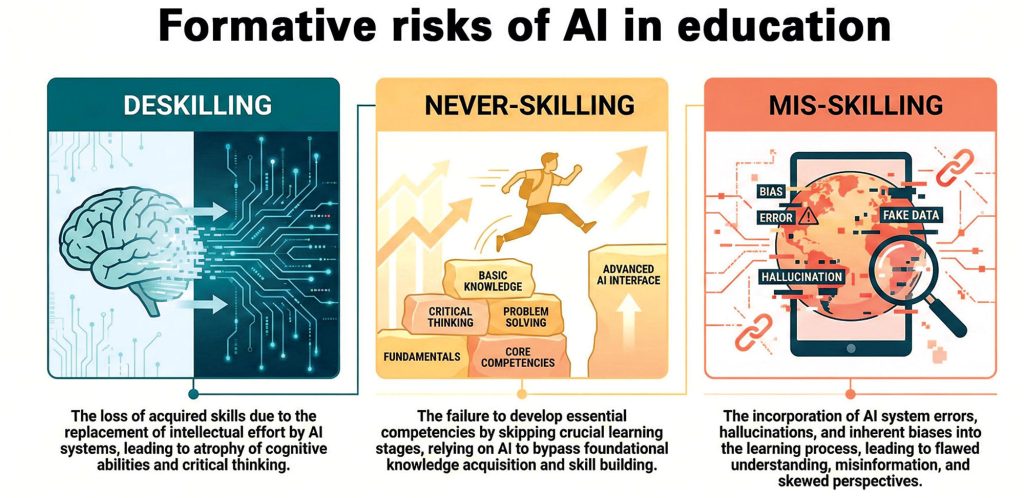
The challenge, however, is not technological in its essence; it is pedagogical. Teaching and learning are deeply contextual, human, and relational processes, permeated by multiple variables, including the methodologies employed, individual cognitive difficulties, life and sociocultural contexts, and even fragmented attention, which is common among the current generation. These factors are not resolved by faster access to answers. The temptation to use AI as a “shortcut,” something we have frequently observed in different educational environments, results in rapid knowledge acquisition at the expense of deep and effective learning. Immediate answers reduce the effort required to build understanding, judgment, and autonomy for decision-making in the real world.
[…]
37